 Vancouver
METRO VANCOUVER NEWS
TransLink needs provincial matching funds to access $1.5 billion in federal transit funding
More than $1.5 billion in federal capital funding for Metro Vancouver transit remains untapped because the previous B.C. government could not provide a matching share, TransLink CEO Kevin Quinn says. The agency also needs a lasting source of operating revenue to maintain service beyond 2027.
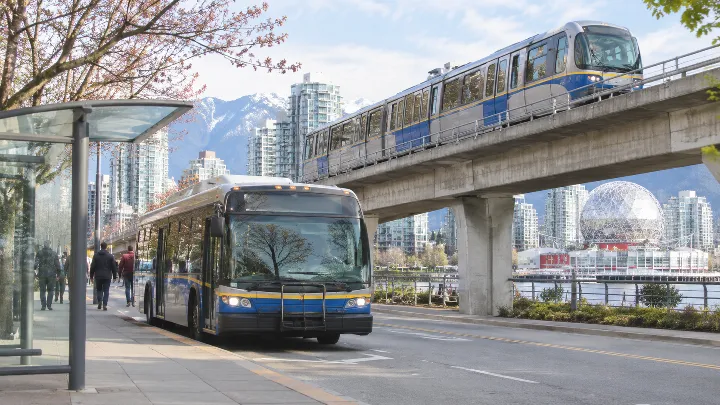
More than $1.5 billion in federal funding for Metro Vancouver public transit projects remains untapped because the previous BC NDP-led provincial government could not provide matching funds, TransLink CEO Kevin Quinn told the Greater Vancouver Board of Trade (GVBOT) on Nov. 20, 2026. Even if TransLink secures the capital funding, it still needs a way to generate ongoing operating revenue to maintain current bus and SkyTrain service levels beyond 2027.
In March 2025, the federal government announced $1.53 billion for TransLink over 10 years through the Canada Public Transit Fund (CPTF), subject to a funding agreement with the provincial government. Quinn said the federal money had been on the table for more than a year, but the previous province could not match it because of financial constraints. He linked those constraints to the province’s significant annual deficit and growing debt; the previous BC NDP administration had said it would slow capital spending on new infrastructure. Quinn said TransLink would like to access the roughly $1.5 billion to build major projects. The money would come through the CPTF’s Metro-Region Agreements stream, which can fund major expansions. The federal government said Metro Vancouver was the first region to benefit from this stream. To qualify, major urban regions and public transit authorities had to implement higher-density, transit-oriented development measures around major transit hubs. Metro Vancouver had an early advantage because of the previous BC NDP provincial government’s Transit Oriented Areas legislation.
Quinn said accessing the CPTF money would also ease pressure on TransLink’s operating budget by reducing how much it needs to borrow and repay in coming years to fund improvements. In January 2025, the federal government announced a separate $663 million for TransLink over 10 years through the CPTF’s Baseline Funding stream, which can be used for maintenance construction and replacement vehicle fleets.
The CPTF was created under former prime minister Justin Trudeau’s federal government. Prime Minister Mark Carney’s government has so far placed less emphasis on the fund, with some dedicated public transit funding redirected to the Building Communities Strong Fund (BCSF), announced in late 2025. Earlier in 2026, Canada’s three largest transit authorities — TransLink, the Toronto Transit Commission and the Société de transport de Montréal — urged Ottawa to restore the CPTF’s full funding and simplify access by cutting red tape and requirements.
TransLink has enough operating revenue to maintain current service through the end of 2027. Its temporary provincial operating subsidy ends just as the agency takes on the cost of running more SkyTrain service. The Millennium Line’s Broadway extension to Arbutus is expected to open in late 2027, followed by the Expo Line’s Surrey-Langley extension in late 2029. The previous BC NDP administration committed to introducing a new revenue source for TransLink in 2027. The agency’s investment plan says the source must generate at least $112 million annually once fully in place in 2028. TransLink also faces growing operating costs, including higher labour costs under recent agreements.
Another pressure on revenue is that drivers are buying less fuel per vehicle. Quinn said vehicles in Metro Vancouver now use about 45 per cent less fuel on average than in 2003, as cars have become more fuel-efficient and more drivers have switched to battery-electric vehicles. TransLink’s regional gas tax once covered 33 per cent of its budget; it now covers 18 per cent, and Quinn expects that share to fall to nine per cent within a few years. He did not say how Metro Vancouver should make up the difference, but pointed to vehicle levies collected at registration in other Canadian provinces and voter-approved public transit sales taxes in the United States.
Quinn cited several examples. Vehicle owners in Montreal pay $184 a year through registration to support public transit. Alberta and Saskatchewan levy $200 and $300 a year, respectively, on battery-electric vehicles. Nova Scotia began collecting a road and highway levy in October 2026: $500 for a battery-electric vehicle and $250 for a plug-in hybrid, every two years.
In Seattle, voters approved doubling the public transit sales tax from 0.15 per cent to 0.3 per cent when the current tax expires at the end of March 2027. Combined with the sales taxes for King County Metro and Sound Transit, the total sales tax dedicated to public transit would rise from 2.45 per cent to 2.6 per cent. On $100 spent on eligible goods and services in Seattle, $2.60 in sales tax would go to public transit. The tax helps pay for improved local bus service. Separately, Quinn credited repeated voter approval of regional sales taxes with helping fund US$30 billion in new Link light-rail expansion construction in the Seattle area.
Recalling Metro Vancouver’s controversial 2015 transit plebiscite, in which voters rejected a proposed 0.5 per cent regional sales tax for TransLink, Quinn said he was not asking the region to revisit the idea. During last month’s provincial election campaign, the BC NDP renewed its promise to give TransLink a new revenue source but ruled out an annual vehicle levy or road pricing. Premier Lorne Doerkson’s Conservatives campaigned on a promise not to raise existing taxes or introduce new ones.
Beyond fares, fees and taxes, Quinn pointed to three TransLink-owned properties where the agency hopes to earn long-term income through high-density residential and commercial development: the former bus depot in North Vancouver’s Moodyville neighbourhood, the park-and-ride lot and bus exchange at Coquitlam Central Station, and Newton Exchange in Surrey.
One such development is already under way in Vancouver. TransLink and PCI Developments broke ground in July 2026 on a 31-storey tower directly across from the future Arbutus Station. It is planned to include 256 secured purpose-built rental homes, retail and restaurant space, and community space. TransLink’s first for-profit building project is expected to be completed in 2029. Quinn said earnings from TransLink’s for-profit real estate division will go back into improving and maintaining transit services, roads and bridges. He cautioned that a few towers at Coquitlam Central would not solve the agency’s problem, which he described as structural and requiring structural solutions.
TransLink faced a similar funding crunch in 2025. It warned then that a projected annual shortfall of $600 million could force it to cut bus service in half, reduce SkyTrain and SeaBus service by up to one-third, and shut down the West Coast Express. In April 2025, the Mayors’ Council and TransLink’s board of directors temporarily averted the cuts by approving a plan that combined $312 million in provincial operating funding between 2025 and 2027 with higher fares, property taxes and parking taxes. That strategy, along with some operating-cost savings, avoided service reductions through the end of 2027 and roughly halved the projected annual shortfall.