 Vancouver
METRO VANCOUVER NEWS
Vancouver Liberals unveil 148-point platform with 400 km of protected bike lanes and an inflation cap on property tax hikes
Kareem Allam’s municipal party proposes sweeping changes to housing, transit, public safety and city services ahead of Vancouver’s Oct. 17 civic election; several plans require support from senior governments.
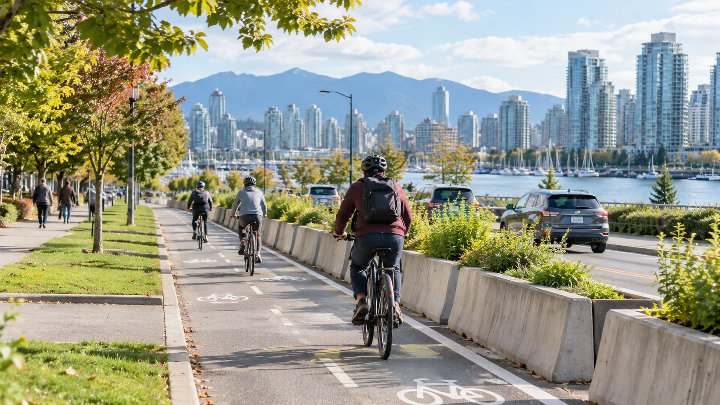
Kareem Allam’s Vancouver Liberals have released a 148-point platform outlining what they would do if elected in Vancouver’s Oct. 17, 2026, civic election. The mayoral candidate said voters should be able to hold the party accountable for specific commitments four years from now. The municipal party is not affiliated with provincial or federal political parties of the same name. It is also seeking commitments from B.C.’s provincial parties ahead of the separate provincial election on Oct. 24. Allam said some of Vancouver’s biggest challenges cross jurisdictional boundaries and cannot be addressed by municipal government alone.
The party would ask the provincial government to outline the legislative steps needed to bring the University Endowment Lands and the University of British Columbia (UBC) into the City of Vancouver’s jurisdiction. It also proposes a plebiscite during the 2030 civic election on whether to retain citywide Vancouver City Council elections, introduce neighbourhood wards with at least some councillors representing wards, or use another system. City Hall proposals include a public lobbyist registry, reversing freedom of information fee increases, restoring the Equity Office and strengthening the Integrity Commissioner. The party also proposes quarterly meetings with the Musqueam, Squamish and Tsleil-Waututh First Nations, and a task force to advance commitments under the United Nations Declaration on the Rights of Indigenous Peoples. It would advocate for an independent audit of Metro Vancouver Regional District and work with other municipalities on governance changes. Its requests to the province include legislation to support regional-district reform and stronger independent oversight of major regional capital projects.
On mental health, addictions and homelessness, the Liberals propose adding housing and early intervention for youth mental health to the existing four pillars of prevention, treatment, harm reduction and enforcement, creating a six-pillar strategy. A strategy addressing methamphetamine would be developed within the first year. The platform says people living in encampments would be offered housing and appropriate support before camps are closed. Allam is calling for a new “Vancouver Accord” involving municipal, provincial and federal governments to assign responsibilities, establish sustained funding and set measurable goals for housing, treatment, mental health, public safety and Downtown Eastside recovery.
The party strongly opposes this election’s public safety plebiscite questions on greater enforcement against public hard drug use and a secure medical treatment facility for voluntary and involuntary care. The facility could be at the former St. Paul’s Hospital or another suitable site in Vancouver. The Liberals say such a facility would be a “prison.” Other social support proposals include free public Wi-Fi in the Downtown Eastside, a property tax exemption for the Greater Vancouver Food Bank’s Vancouver facilities, and food hubs in vacant City-owned spaces offering affordable groceries and support.
Public safety proposals include funding 15 additional Vancouver Police Department financial-crime investigators to trace drug-trade profits and pursue organized-crime leaders. Community policing centres would receive more stable funding, while crisis services would expand through Peer Assisted Care Teams and Car 87. The party also promises to fill funded positions on nurse-led crisis teams and establish a violence-prevention unit involving police, schools, health services and community organizations.
Housing policy would simplify approvals and expand support for renters, co-ops and other affordable homes. The Liberals propose adopting the B.C. Building Code while retaining Vancouver’s stronger zero-carbon and energy standards and heritage protections. Vancouver has its own building code; all other municipalities in the province follow the provincial code. The party would combine the City’s 12 housing-approval departments into a single process with one contact for applicants, and review construction-related bylaws in its first year. Churches, co-ops and non-profit organizations would be allowed to build affordable and non-market housing on their land without rezoning. Development charges would be revised with phased rates and exemptions for priority housing. Developers’ contributions toward neighbourhood amenities in exchange for rezoning would be collected in cash and publicly disclosed.
The party would reverse the City’s current pause on net new supportive housing and seek provincial help to build and operate supportive housing with sufficient staffing and health services. New supportive-housing and shelter operators would have agreements setting out their responsibilities, staffing commitments and service standards for the City to enforce. For existing co-op and non-profit housing on City-owned land, the Liberals promise immediate lease extensions and automatic renewals, municipal financing for repairs and additional public land for new projects. A community land trust would hold City-owned land for affordable housing, child care and recreation. The City’s Renters’ Office would return, with protections against displacement during major redevelopment, including projects under the Broadway Plan. The previous, short-lived Renter’s Office was closed by ABC-majority City Council in January 2023 after very low usage. It handled roughly 370 inquiries a year, or about one call per day. ABC also argued that it duplicated renter assistance from the provincial government and non-profit organizations. The platform calls for keeping a substantial share of new Downtown Eastside social housing at shelter-level rents and reserving some required below-market homes in new developments for essential workers, including nurses, teachers, firefighters and paramedics.
The Liberals would seek provincial assistance to demolish the Georgia and Dunsmuir viaducts. After demolition, they would proceed with the City’s 2016-approved Northeast False Creek Plan for a mixed-use district with residential and commercial space and expanded waterfront parkland. The demolition plan and implementation of the area plan are stalled. They depend on revenue from new market strata condominium projects to cover significant costs for infrastructure and public benefits, including demolishing the viaducts and building a replacement surface road network. Those residential developments are not proceeding in part because of current challenging economic conditions.
The party describes extending SkyTrain’s Millennium Line from Arbutus to UBC as its top public transit priority. It would also advocate for additional rapid transit serving areas such as Stanley Park, Hastings Park/PNE and South Vancouver. The Liberals would work with TransLink on full-time bus lanes along Hastings Street between Downtown Vancouver and Boundary Road, with traffic signals giving buses priority. On the Downtown Vancouver peninsula, signals on one-way streets would be synchronized to improve traffic flow. The party would keep bus routes on Howe and Seymour streets while continuing pedestrianization efforts on Granville Street after this year’s pedestrian-zone success. It proposes adding 400 km of protected bike lanes, including by adding protection to existing painted lanes. Other transportation proposals include safer intersections, secure bicycle storage, more charging infrastructure and a summer bus route connecting Vancouver’s beaches. The platform also proposes asking the Vancouver Airport Authority to rename Vancouver International Airport “Terry Fox International Airport.”
Much of the Liberals’ $1.35 billion in parks and recreation capital spending would replace or upgrade aging pools, ice rinks, community centres and public spaces. Funding would continue into the 2031–2034 capital plan to complete major projects. The party promises to redevelop the Vancouver Aquatic Centre with a 50-metre pool, compared with the currently approved plan for a 25-metre main tank. Demolition of the existing facility is scheduled to begin this month. The platform also proposes renewing Renfrew Community Centre and working with local developer Wesgroup and Metro Vancouver Regional District to build the new River District Community Centre.
The Liberals propose “renaturalizing” the now-closed Hastings Racecourse at Hastings Park as the “Eastside’s Stanley Park,” instead of pursuing potential major entertainment, sports and event uses for the site to help restore the PNE as a major regional entertainment institution. The PNE was forced to downsize considerably after many event buildings and functional fairgrounds were demolished in the late 1990s and early 2000s to create parkland and green space. It has not recovered. The party would eliminate paid parking at beaches and community centres, restore the Stanley Park miniature train and bring back beach lifeguard coverage, including at Trout Lake. It would also expand funding for a recreation pass providing low-income residents free or reduced-cost access to pools and community centres. The Liberals support retaining the separately elected Park Board and giving commissioners greater control over staff and spending.
Environmental commitments include faster sewer separation to reduce untreated discharges into local waters, more recycling facilities and a rat-control strategy developed with public-health and pest-control specialists. The party would explore smart waste collection technology, including underground bins, sensors that detect when public garbage bins are full and automated sorting. A paid Youth Climate Corps would plant and maintain trees, restore habitat and help communities during heat and smoke events. Libraries and community centres would stay open later during warnings to provide cooler spaces and cleaner air. The City would establish transportation-emissions targets and report progress annually.
On property taxes, the Liberals would set an inflation cap on increases and reorganize the municipal bureaucracy with fewer management layers and reviews, requiring departments to show the value of their spending. A major hiring campaign would add 400 unionized frontline employees to support longer library and community-centre hours, more frequent garbage collection and street cleaning, and better maintenance of parks and sports fields. An early repair and cleanup campaign would target potholes, graffiti and litter, with an online tracker showing service results and response times. The party also proposes an independent municipal board to oversee fire-services funding and deployment, along with a gradual increase in firefighter staffing. The board would be similar to the Vancouver Police Board, which oversees the Vancouver Police Department.
On the economy, the Liberals would re-establish the Vancouver Economic Commission (VEC), a municipally funded, arm’s-length organization that promoted Vancouver internationally and provided business support and investment-attraction capacity. It closed after nearly three decades for reasons that included reducing municipal operating costs and avoiding duplication with Metro Vancouver Regional District’s newly created Invest Vancouver agency. The party would create a single entry point for business permitting, with a target of reducing approval times to three months. It proposes allowing small shops, cafés and restaurants throughout residentially zoned areas, simplifying permits for temporary shops and markets, making rules more flexible for businesses sharing premises, and permitting a wider range of tourist accommodations, including hostels and pod hotels.
A new industrial land reserve would protect space for industrial employment. Four separate areas would be designated for artist studios and production, with property taxes on those spaces cut by 50 per cent. A proposed “Vancouver Arts Council” would advise the City on cultural funding and space needs. The platform also proposes lower property taxes for family doctors’ offices and a joint renewal plan with the federal government for Granville Island, including steps to keep space affordable for artists and small businesses.
To keep the Vancouver Whitecaps in the city, the party would pursue private investment, potentially including new local ownership or a privately financed stadium. The platform says public land would remain publicly owned and taxpayers would not bear the cost. The Liberals would also help initiate a bid for the new CANZUK headquarters, with the stated aim of championing Vancouver as the North American home of the Canada, Australia, New Zealand and United Kingdom partnership on trade, migration and foreign policy. In addition to Allam as mayoral candidate, the party has seven candidates for Vancouver City Council, six for Park Board and five for School Board.