 Vancouver
METRO VANCOUVER NEWS
Victoria and Saanich voters will decide whether to pursue amalgamation in a non-binding plebiscite
The Oct. 17 vote will ask whether the municipalities should become one, but a yes result in both communities would only support further study; a binding referendum is not yet authorized.
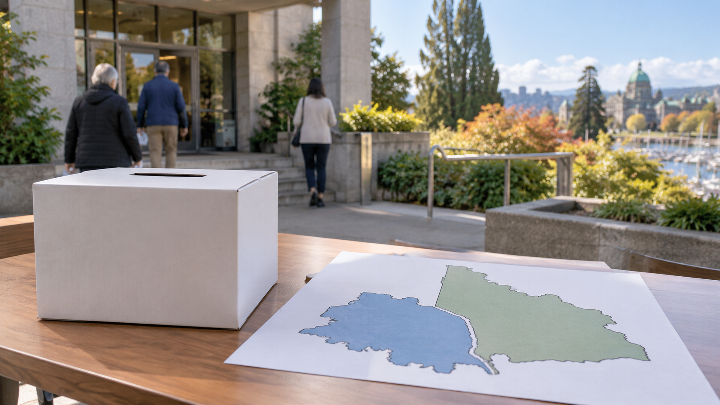
Voters in the City of Victoria and the District of Saanich will be asked the same question during the Oct. 17, 2026, civic election: “Do you support Saanich and Victoria becoming one municipality?” The plebiscites are non-binding, so even majority support in both communities would not automatically trigger a merger. Further study and provincial government involvement would be needed before a legally binding referendum could be considered.
According to the District of Saanich, a majority voting yes in each municipality would signal clear public support for the newly elected councils to pursue that additional work. If voters in either community reject the proposal, work on amalgamation would stop.
Amalgamation would bring the two local governments and their operations under one larger municipal government. The provincial statistics bureau puts the municipalities’ combined population at 230,000 in 2025: 126,000 in Saanich and 104,000 in Victoria. That is comparable to the City of Burnaby. By 2046, the combined population is expected to reach 257,000, including 135,000 in Saanich and 122,000 in Victoria.
The City of Victoria covers 19.5 square kilometres, slightly more than the City of New Westminster. Immediately north of Victoria, the District of Saanich covers 104 square kilometres, comparable in size to the City of Vancouver. Saanich is the largest and most populous of the 13 municipalities in the Capital Regional District. A merged city would have a total land area of nearly 124 square kilometres.
The plebiscites follow a lengthy process that received initial public backing in the 2018 civic election. Voters in both communities supported spending to create a Citizens’ Assembly to examine possible amalgamation, and the provincial government provided some funding. After pandemic-related delays, the assembly worked in 2024 and 2025, including extensive public consultation. It recommended amalgamation and delivered its final report to the two councils in July 2025.
The assembly said it recommended amalgamation after considering costs, benefits and disadvantages to the best of its abilities and using the information available. It concluded a unified city would be the best form of government for the two municipalities, saying their administrative border is invisible, residents’ lives are intertwined and governance should reflect that reality. It found no significant barriers to amalgamation in the materials it reviewed. Members said a unified municipality could improve coordination and long-term planning for housing, transportation, infrastructure and emergency services, while clarifying responsibility for decisions.
The assembly did not recommend whether the resulting city should take the name “Victoria” or “Saanich,” saying that choosing a name or naming process was outside its mandate. Its final report says amalgamation could create an opportunity for a renaming process in partnership with First Nations. That is only a potential future step; whether the provincial capital could get a new name would depend on amalgamation ultimately proceeding.
Major financial questions remain unanswered. The District of Saanich said the assembly’s report did not include a comprehensive estimate of merger costs or the potential effects on property tax rates. Following the assembly’s recommendation, the two mayors formally asked the provincial government in October 2025 to allow a legally binding referendum during the October 2026 civic election. The province rejected the request, saying more work was needed before a binding public vote.
In an April 2026 letter to the mayors, B.C. Minister of Housing and Municipal Affairs Christine Boyle said the province needed more detailed information about the financial consequences, the transition to a merged municipality, governance changes and effects on municipal services. She also required consultation with affected First Nations. Boyle said the municipal governments could hold a non-binding vote during the October 2026 civic election without provincial approval to further gauge public opinion.
Vancouver residents will also vote in a non-binding advisory public-safety plebiscite during the civic election. It asks about enhanced enforcement against hard-drug use in public spaces and creating a new secure medical treatment facility, with both voluntary and involuntary care, for people with severe mental-health and addiction issues.