 Vancouver
METRO VANCOUVER NEWS
Wildfire smoke worsening B.C. air quality, lung foundation says
A new BC Lung Foundation report says wildfire smoke is a growing health threat, with PM2.5 pollution linked to about 1,900 premature deaths in B.C. each year.
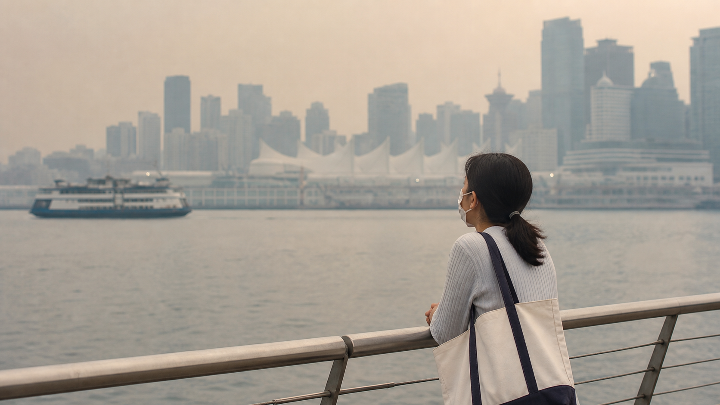
Wildfire smoke has become a leading source of fine-particle pollution in British Columbia and a growing public-health concern, according to the BC Lung Foundation’s 2026 State of the Air Report.
The foundation says PM2.5 particles in smoke can reach deep into the lungs, causing immediate airway irritation and contributing to longer-term heart and lung disease. It estimates PM2.5 is associated with about 1,900 premature deaths in B.C. annually. People with chronic conditions, pregnant people, infants and young children, older adults and those with respiratory infections may be especially vulnerable.
The report identifies pronounced pollution spikes during major wildfire seasons, including 2018, 2023 and 2024. Although 2025 was less destructive than the previous two seasons, 886,300 hectares burned—above the 10-year average—and smoke warnings were issued in more than 30 areas between late July and September, including Metro Vancouver.
During early-September smoke events, Metro Vancouver’s Air Quality Health Index reached 10+, prompting advisories from Environment and Climate Change Canada and a decision by the Vancouver School Board to move outdoor activities indoors. At that risk level, the public is advised to reduce or reschedule strenuous outdoor activity, while higher-risk people should avoid it.
The foundation recommends staying indoors, using an air cleaner or a DIY box-fan cleaner, seeking cleaner-air spaces and wearing a respirator such as an N95 outdoors when air quality is poor. Of 59 provincial monitoring sites in 2025, 12 recorded PM2.5 levels above B.C.’s daily objective of 25 micrograms per cubic metre; outside Valemount’s winter wood-smoke issue, wildfire smoke was the principal cause of elevated levels, the report says.