 Vancouver
METRO VANCOUVER NEWS
Carney advances Canada-China strategic partnership in trade, business and culture
Canada and China are expanding tariff relief for selected Canadian exports and announcing new trade, e-commerce, education and environmental initiatives. Air Canada plans a Vancouver-Guangzhou route in May 2027, while the two leaders also welcomed business agreements and discussed security and energy cooperation.
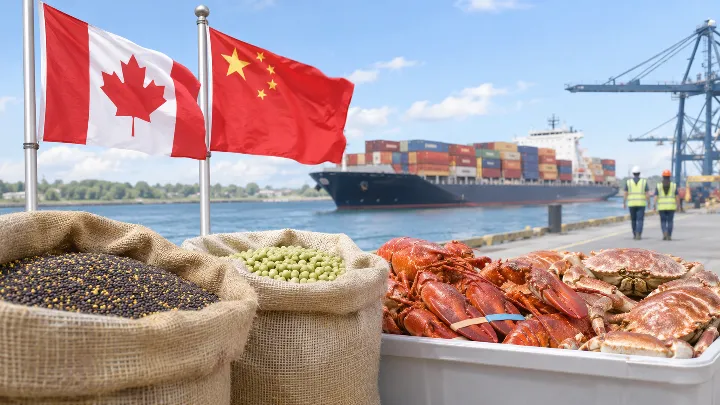
Canada’s government says it has recalibrated the relationship with China over the past 18 months. In January last year, Prime Minister Mark Carney and Chinese President Xi Jinping launched a strategic partnership intended to stabilize trade, build clean-energy industries and strengthen connections between their peoples. Since then, the countries have expanded economic and financial cooperation and cultural exchanges, and reduced tariffs on Canadian canola seed and meal, peas, crab and lobster. Canada says it has restored market access for more than 90 per cent of trade previously subject to tariff action, representing nearly $7.5 billion in Canadian exports. Carney met Xi in Shenzhen on Tuesday, and the leaders agreed on further measures to expand trade.
The countries are extending and expanding the Preliminary Joint Arrangement on Addressing Bilateral Economic and Trade Issues. Ottawa says the expansion will improve Chinese-market access for Canadian farmers and seafood harvesters and provide additional tariff relief for about $400 million in Canadian exports. That includes $116 million in frozen pork cuts and $285 million in fish and seafood exports. Covered products include certain frozen cold-water shrimp and prawns, including Pacific spot prawn; certain molluscs, including geoduck; sea cucumber; and Greenland halibut. The expansion builds on a two-year extension, announced earlier this month, of tariff relief for Canadian canola meal, peas, lobster and crab.
In return, Canada has agreed to extend by two years existing remission measures for certain Chinese steel and aluminium products. Those measures are scheduled to expire at the end of 2026. Canada will also expand the remissions to 32 additional steel and aluminium tariff items for which Canadian supply is insufficient or unavailable.
To create opportunities in investment, education and exchanges, Carney announced several initiatives. The two countries endorsed joint outcomes from the second Canada-China Economic and Financial Strategic Dialogue, which aim to strengthen economic, trade and financial ties through practical cooperation among financial, macroeconomic, regulatory and monetary authorities. Canada plans a major trade mission to China in 2027 to connect Canadian businesses with Chinese industry leaders. The countries will also designate 2027 the Canada-China Year of e-Commerce, an initiative intended to help Canadian small and medium-sized businesses compete, diversify and grow through Chinese e-commerce platforms.
Canada is contributing $850,000 to scholarships under the Canada Learning Initiative in China, enabling 850 Canadian students to study at Chinese universities. It is also contributing $8 million to the China Council for International Cooperation on Environment and Development. The contribution is intended to mobilize international expertise, including from Canadian researchers, and support science-based recommendations to policymakers.
During the visit, Carney and Xi welcomed business agreements and investments. Air Canada plans to launch flights from Vancouver to Guangzhou in May 2027, and Chinese airlines are also increasing flights. Five Canadian companies in the arts and culture sector signed commercial agreements worth more than $15 million. A memorandum of understanding will establish a Canada-China CEO Roundtable, co-chaired by the Canada-China Business Council and the Bank of China, as a forum for business-to-business exchanges. The University of Ottawa (uOttawa) and Shanghai International Studies University (SISU) signed a separate memorandum to develop an undergraduate dual-degree program. It would combine uOttawa’s expertise in international studies and modern languages with SISU’s research strengths in French studies and diplomacy.
The leaders also discussed recent dialogues on stronger border and customs cooperation against narcotics threats, and collaboration with energy-industry leaders on oil and gas, renewable energy and nuclear energy. China, the world’s second-largest economy with a population of more than 1.4 billion, is central to Canada’s engagement in the Indo-Pacific. Trade with China supports hundreds of thousands of jobs across Canada, from Prairie farmers to manufacturers in Ontario and Quebec and fish harvesters in Atlantic Canada and British Columbia. The trade generates more than $30 billion in revenue and adds $6.9 billion to Canada’s GDP. The government says expanded access to one of the world’s largest markets will create new opportunities for commercial, scientific and cultural collaboration and strengthen ties between the countries’ peoples. Carney is in Shenzhen to represent Canada at the Asia-Pacific Economic Cooperation Economic Leaders’ Meeting.
Carney said the countries’ recalibrated relationship has benefited people in both countries and unlocked billions of dollars in new export orders for Canadian farmers, ranchers and fish harvesters, as well as workers and businesses across the country. He said Canada and China are making it easier to travel, study and do business between the countries, and that Canada is building strength at home and diversifying relationships abroad to preserve people’s freedom to choose how they live.
Carney is accompanied in Shenzhen by Foreign Affairs Minister Anita Anand and Parliamentary Secretary to the Prime Minister Kody Blois. In 2025, bilateral merchandise trade reached $125.6 billion, up 5.6 per cent from 2024. China accounted for $35.1 billion of Canada’s merchandise exports that year. China’s foreign direct investment stock in Canada stood at $43.4 billion in 2025, making it the fourth-largest investor country. Canada’s direct investment stock in China was $15 billion, and China ranked as the 19th-largest destination for Canadian direct investment abroad.