 Vancouver
METRO VANCOUVER NEWS
U.S. Congress is up for grabs in these midterm races to watch
Control of Congress is at stake in next Tuesday’s U.S. midterms. Democrats are close to the House majority, while tight Senate contests in Michigan, Maine and other states could shape the outcome and put President Donald Trump’s trade policies toward Canada in focus.
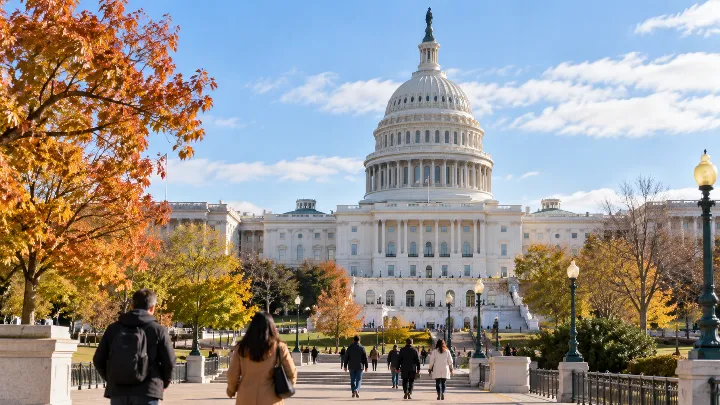
Republicans and Democrats are intensifying their campaigns ahead of next Tuesday’s U.S. midterm elections, with control of Congress at stake. Republicans are trying to preserve their narrow congressional majority and what remains of President Donald Trump’s governing agenda. Democrats see an opportunity to restrain Trump’s unprecedented use of presidential powers for the rest of his term.
Polling suggests Democrats are close to taking the House. A net gain of three seats would give them a narrow majority. U.S. midterm results tend to swing against the sitting president’s party, and Trump’s deeply unpopular policies, rising inflation and the war with Iran are putting many Republicans at risk. Marc Trussler, director of data science for the University of Pennsylvania’s Program on Opinion Research and Election Studies, said polling shows sentiment toward Trump and his administration has soured, with a downward trend over the past two years. At this point, he said, it would be “a big surprise” if Democrats failed to win the House.
The fate of congressional resistance to Trump may ultimately hinge on a handful of closely contested Senate races. In some of those states, Trump’s trade war with Canada is a major campaign issue. Democrats need a net gain of four seats to take the Senate majority. They must hold seats such as Michigan’s while gaining others, including in Maine. Trussler, who is Canadian, said both races are within the margin of error and will involve Canada explicitly.
Trump’s attacks on Canada have become a polarizing election issue, particularly in Michigan, whose economy is deeply integrated with Canada’s. Trump’s decision to hold up the opening of the Gordie Howe International Bridge has featured prominently in the campaign, as has the drop in Canadian visitors driven by his anti-Canada rhetoric. The backlash over the trade war has led Republican Senate candidate Mike Rogers to distance himself from Trump. In a campaign ad released earlier this month, Rogers drinks a Labatt’s beer and tells voters, “Canada is not our enemy.” Christopher Sands, director of Johns Hopkins University’s Center for Canadian Studies, said Rogers has been walking on eggshells, trying to avoid alienating Trump while telling voters he would stand up for Michigan.
If Democrats cannot hold Michigan, their path to flipping the Senate becomes much harder. Democratic candidate Abdul El-Sayed, who has said the trade war with Canada makes no sense, has no clear lead in the state’s race. Trump and Republicans have repeatedly targeted him. Opponents have raised past controversial comments and suggested he has ties to the Muslim Brotherhood. Sands said El-Sayed would lose because of some of his more controversial remarks, not his position on Canada.
In Maine, the outlook for longtime Republican Senator Susan Collins could also hinge on Trump’s trade war. The Trump administration recently changed its 50 per cent tariffs on Canada to reduce the impact on Maine, in a move intended to help Collins ahead of the election. Collins has held the seat for 30 years and presents herself as an independent-minded Republican who can work with the Trump administration for her state’s benefit. She has long opposed Trump’s tariffs on Canada.
Maine voters are unhappy with Trump policies that have driven up energy prices and caused Canadian tourism to plummet. Democrats, however, have struggled to get their message across since their initial candidate, Graham Platner, dropped out amid allegations of sexual assault. His replacement, Troy Jackson, made tariffs on Canada a key campaign issue after taking over in July. Jackson has accused Collins of enabling Trump’s chaos and points out that she voted to confirm people driving the president’s unpopular policies.
Canada may not be top of mind for voters in other close races, but the economic effects of Trump’s policies are major motivators, Trussler said. The most likely path for Democrats to control the Senate also involves flipping seats in Alaska, Iowa, North Carolina, Ohio and Texas, all of which have significant trade relationships with Canada.
In Ohio, Republican Senator Jon Husted is facing former Democratic candidate Sherrod Brown. Husted was appointed to the seat in 2025, succeeding JD Vance, who previously held it and is now vice-president. Trump has repeatedly commented on Husted’s body at campaign events, drawing attention to the senator. Trump carried Ohio in each of the last three presidential elections, but Brown, who lost a race for the state’s other Senate seat in 2024, has consistently outperformed Democratic presidential candidates there.
Another closely watched contest is in Texas, where scandal-plagued Republican candidate Ken Paxton faces Democratic nominee James Talarico, a state representative. Texas has not elected a Democrat to statewide office since 1994. Democrats hope Paxton’s unpopularity, including among Republicans, will give Talarico a chance to win in the Lone Star State.
This Canadian Press report was first published Oct. 29, 2026. Kelly Geraldine Malone contributed for The Canadian Press, with files from The Associated Press.