 Vancouver
METRO VANCOUVER NEWS
Mark Carney and Abu Dhabi Crown Prince Sheikh Khaled issue joint statement on Canada-UAE ties
During Sheikh Khaled bin Mohamed bin Zayed Al Nahyan’s first official visit to Canada, the two leaders elevated bilateral relations to a Strategic Partnership and outlined cooperation spanning trade, investment, defence, energy, technology and people-to-people ties.
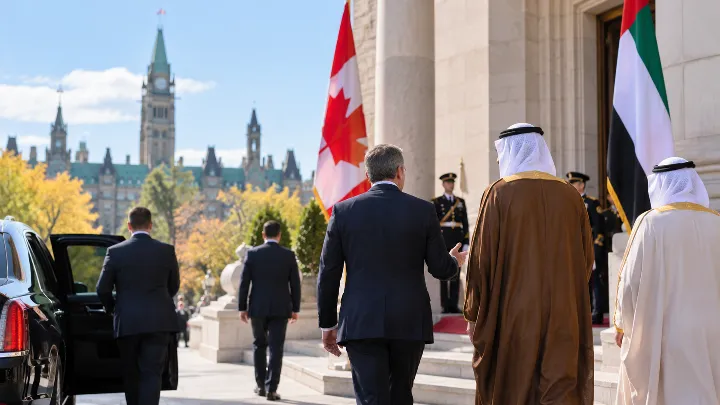
Prime Minister Mark Carney received Abu Dhabi Crown Prince Sheikh Khaled bin Mohamed bin Zayed Al Nahyan and accompanying senior ministers in Ottawa from Oct. 26 to 27, 2026, during the Crown Prince’s first official visit to Canada. Following the 50th anniversary of diplomatic relations in 2024, the visit was described as a significant milestone. The leaders reviewed progress on trade and investment, defence and security, energy, advanced technology and artificial intelligence, infrastructure, telecommunications, space, food and water security, critical minerals and international cooperation. They agreed to elevate Canada-UAE relations to a Strategic Partnership.
The partnership provides a framework for deeper cooperation in diplomacy, trade and investment, energy and critical minerals, defence and security, advanced technologies and artificial intelligence, international assistance, education and people-to-people ties. The leaders said regular dialogue and coordination between the governments would support long-term collaboration and identify opportunities to advance mutual interests. They described the arrangement as reflecting commitments to international peace and security, economic openness, innovation, effective multilateralism and sustainable development.
On trade, the leaders noted that negotiations on the Comprehensive Economic Partnership Agreement (CEPA) concluded in 47 days, on July 24, 2026, and witnessed the agreement’s signing during the visit. They welcomed continued growth in bilateral trade, with merchandise trade reaching approximately CAD $3.5 billion in 2025, a significant increase over the previous year. They committed to strengthening supply chains, increasing investment flows, expanding private-sector engagement, reducing unnecessary trade barriers and improving access to each other’s markets. They said CEPA would create opportunities for businesses, workers, investors and entrepreneurs. The leaders reaffirmed support for open, predictable, rules-based trade and closer commercial ties in strategic sectors including transportation, logistics, infrastructure, advanced manufacturing, critical minerals, agriculture, life sciences, energy and digital technologies. They committed to close cooperation to unlock CEPA’s potential while respecting each party’s right to regulate in areas of national importance, including national security, energy and culture. They also highlighted the expanded bilateral air transport agreement of 2025 as important to exchanges, tourism, trade, investment and business links. Economic partnerships announced during the visit, they said, would support the Strategic Partnership and diversify global supply chains.
On investment, the leaders reaffirmed their commitment to implementing the Canada-UAE Investment Framework and referred to the UAE’s commitment to facilitate up to CAD $70 billion in strategic investment opportunities in Canada. They welcomed increased cooperation among Canadian and Emirati investors, financial institutions, pension funds, development finance institutions and sovereign wealth funds following the inaugural Canada Investment Summit. Abu Dhabi Chamber and Invest in Canada signed a memorandum of understanding to strengthen business collaboration, facilitate two-way investment, identify commercial opportunities and increase private-sector engagement. Both sides committed to closer cooperation among leading financial institutions, sovereign wealth funds, pension funds and investment platforms. Canada welcomed a planned investment engagement mission to the UAE led by the Minister of Finance and accompanied by senior representatives of major Canadian pension funds and financial institutions. The leaders also cited the Canada Investment Summit, Abu Dhabi Sustainability Week, ADIPEC and future bilateral business forums as platforms for long-term commercial partnerships and investment.
The statement says DP World is working with partners and investing in infrastructure, technology and integrated logistics capabilities to make Canada’s supply chains more reliable, resilient and competitive. Arctic Gateway Group, CentrePort Canada Inc. and DP World in Canada signed a memorandum of understanding to pursue strategic trade growth opportunities. It focuses on port operations and logistics services, as well as the potential development of an integrated transportation corridor linking the Port of Churchill, the Hudson Bay Railway, CentrePort Canada and DP World’s global logistics network.
On defence and security, the leaders committed to stronger cooperation amid regional instability, emerging technological threats, cyber risks, supply-chain vulnerabilities and maritime security challenges. They underscored the importance of secure maritime trade routes, freedom of navigation and resilient global supply chains to international security and economic prosperity. They welcomed the conclusion of a Canada-UAE Memorandum of Understanding on Defence Cooperation, covering joint exercises, cybersecurity, information sharing, digital transformation and professional military exchanges. The memorandum establishes a Joint Military Committee to advance strategic dialogue, strengthen military-to-military engagement and support shared defence objectives. The leaders also confirmed ongoing efforts to connect Canada’s defence innovation ecosystem with the UAE’s advanced defence industry, including cooperation involving the UAE’s EDGE model and Canadian research, development and industrial capabilities. They encouraged more defence-industry partnerships between businesses. They said coordination and collective action are essential to security, stability and prosperity at home and abroad as threats evolve, technology changes rapidly and geopolitical complexity grows.
On public safety, both countries reaffirmed the rule of law and said criminals should not be able to exploit international borders to evade justice. Canada and the UAE expressed an intention to begin negotiations on a bilateral extradition treaty and a Mutual Legal Assistance Treaty (MLAT) to strengthen criminal-justice cooperation and efforts against international crime.
On energy and critical minerals, the leaders described the Canada-UAE energy partnership as important to global energy security, sustainable economic growth, supply-chain resilience and an orderly, pragmatic energy transition. Masdar signed an Energy Cooperation Arrangement with Natural Resources Canada to establish a framework for investment in Canada’s renewable energy and energy storage sectors. It will allow Masdar to explore opportunities with Canadian companies and investors and strengthen cooperation on renewable-energy policy and investment. The leaders welcomed growing partnerships between Canadian and Emirati companies and said the countries have complementary strengths in conventional and next-generation energy systems. They welcomed strong interest from UAE investors in Canadian liquefied natural gas (LNG) opportunities and related infrastructure, noting the potential for significant investment in LNG export facilities and associated midstream infrastructure. They also identified opportunities in wind energy, clean electricity, hydrogen, natural gas and LNG infrastructure, carbon-management technologies, energy innovation and other low-carbon solutions, including partnerships among industry, research institutions, investors and governments. The leaders welcomed growing UAE interest in Canada’s critical-minerals sector and committed to exploring mutually beneficial partnerships supporting responsible resource development, innovation, supply-chain resilience, environmental stewardship and sustainable economic opportunities for local communities.
On artificial intelligence, space and technology, the leaders recognized advanced technologies as drivers of innovation, economic growth, productivity and competitiveness. Canada and the UAE will aim to deepen cooperation in artificial intelligence, quantum computing, advanced robotics, cloud computing, secure digital infrastructure, telecommunications and space technologies. Drawing on Canada’s research expertise and the UAE’s investment capacity and technology infrastructure, including collaboration between the Technology Innovation Institute (TII) and the Quebec Artificial Intelligence Institute (MILA), they will seek to accelerate innovation, develop talent, exchange knowledge and advance responsible technology governance so scientific advances can produce practical solutions. The leaders also discussed new approaches to technology diplomacy based on secure, resilient digital infrastructure and stronger foundations for trusted digital cooperation. They said the initiatives reflect growing momentum and a shared ambition for a future-ready innovation partnership.
On water, the leaders said water security is essential to economic prosperity, public safety and well-being, peace and stability, and healthy, resilient ecosystems. They emphasized international cooperation on global water challenges and sustainable water management. They highlighted the 2026 United Nations Water Conference, co-hosted by the UAE and Senegal in Abu Dhabi from Dec. 8 to 10, 2026, as an opportunity to accelerate progress toward Sustainable Development Goal 6. The UAE welcomed Canada’s participation, represented by the Canada Water Agency. The leaders called for global water commitments to be turned into action through partnerships, innovation, investment, capacity-building and sustainable solutions. They also cited the 2027 Our Ocean Conference, which Canada will host, as an opportunity for international cooperation on ocean and water governance, and expressed mutual interest in bilateral water-management ties under the Strategic Partnership.
On polar research, the UAE’s Emirates Polar Program (EPP) and Canada’s Polar Knowledge Canada recognized the importance of science and international cooperation in understanding the cryosphere and its role in the global climate system. The leaders expressed interest in stronger research ties in climate research, oceanography, Earth observation, cryosphere science, scientific innovation and capacity-building to exchange knowledge and advance shared scientific objectives.
On the environment, agriculture and food security, the leaders underscored the strategic importance of cooperation on agriculture, food security, environmental sustainability, circular-economy initiatives and climate resilience. They identified opportunities to expand trade and investment, diversify food supplies, strengthen agricultural supply chains, improve food corridors, support fertilizer cooperation and advance agri-food innovation and technology. They reaffirmed a shared commitment to sustainable resource management, environmental stewardship, and climate-resilient, water-efficient agriculture. They also discussed joint development work in third countries to improve agricultural productivity, strengthen food systems and support sustainable-development objectives.
On international cooperation, the leaders reaffirmed their commitment to addressing global challenges and supporting sustainable development. They welcomed opportunities for innovative international-assistance partnerships in Africa, the Americas, the Middle East and other developing regions. Building on complementary strengths in development finance and sustainable investment, they discussed co-financing infrastructure, advancing health initiatives, supporting food security, strengthening climate resilience and promoting responsible critical-minerals development. They welcomed growing cooperation between development finance institutions, including FinDev Canada and Alterra, and encouraged exploration of financing mechanisms to mobilize public and private capital for sustainable development. They also discussed trilateral cooperation in sustainable infrastructure, agriculture, health services, critical minerals, capacity-building, food security, innovative financing and economic development, saying it could amplify the partnership’s impact and support resilience and prosperity in partner countries. The two nations said their expertise, institutions and international networks could help respond to crises and emerging challenges, deliver development outcomes, build resilience and support long-term stability. Anwar Gargash Diplomatic Academy and Global Affairs Canada signed a memorandum of understanding on Diplomatic Development and Learning to develop joint training, education, diplomatic learning and leadership programs, and expand cooperation in diplomacy and international relations.
On people-to-people ties, Canada and the UAE celebrated the human connections underpinning their relationship. They committed to expanding cultural, educational, scientific and professional exchanges, strengthening mobility and connectivity, and promoting cooperation in health care, research and innovation. More than 60,000 Canadians live in the UAE, including more than 13,000 students, while growing numbers of Emirati students study at Canadian institutions. The leaders said these links reflect strong education cooperation and underscored the importance of investing in youth through academic exchanges, leadership development, professional training and community engagement to build lasting relationships and mutual understanding.
On tolerance, both leaders expressed concern that the spread of extremism and extremist ideologies fuels terrorism, violence and conflict. In line with United Nations Security Council Resolution 2686, they reaffirmed their commitment to addressing hate speech, extremism, racism and intolerance through tolerance, mutual respect, interreligious dialogue and intercultural understanding. Both countries firmly reject extremism in all its forms and manifestations.
On sovereignty and international law, both countries reaffirmed the purposes and principles of the United Nations Charter and the importance of international law, respect for sovereignty and territorial integrity, non-interference in internal affairs and the peaceful settlement of disputes. The leaders reaffirmed their shared commitment to regional stability, international security, civilian protection, freedom of navigation and the international legal order. They welcomed continued cooperation in support of international and United Nations efforts to promote peace, security and stability. The statement called for an end to the occupation of the UAE’s three islands—Greater Tunb, Lesser Tunb and Abu Musa—which it said violates the UAE’s sovereignty and the principles of the United Nations Charter.