 Vancouver
METRO VANCOUVER NEWS
B.C. mill closures threaten reforestation capacity, experts say
Experts say mill closures in B.C. are weakening the processing capacity and harvesting revenues that help fund reforestation, leaving more forest fuel and fewer resources for restoration.
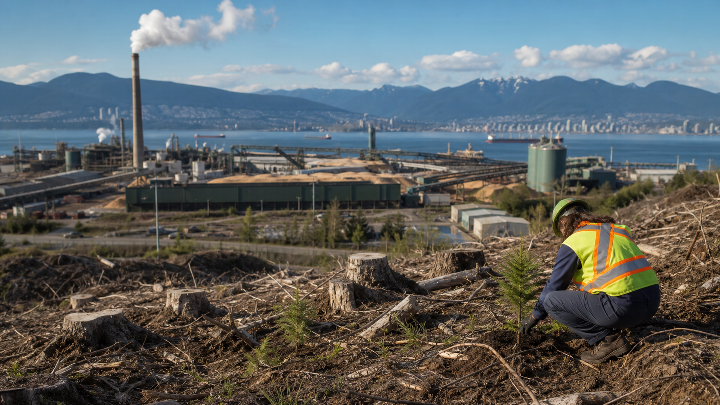
Forestry experts say continuing mill closures in British Columbia could undermine forest restoration by removing the processing capacity and harvesting revenues that support reforestation work.
Canfor announced in July that it plans to close its Prince George pulp mill. More than 20 B.C. lumber mills have closed permanently or indefinitely since 2023, eliminating thousands of jobs and creating gaps across the sector.
John Betts, executive director of the Western Forestry Contractors Association, said forests contain substantial biomass that needs treatment. Without facilities that can process and sell it, he said, material that could support a wood-products economy may be wasted or add to wildfire fuel.
Timo Scheiber, CEO of Brinkman Reforestation and president of the association, said reforestation is often funded through harvesting. He said the province’s annual tree planting has fallen from about 300 million trees in the early 2020s to roughly 230 million, likely reducing both the workforce and research funding.
Federal and provincial planting commitments remain in place. The federal tree program stopped accepting new applications in 2025; by June of that year, 228 million trees had been planted nationally out of 998 million committed. In B.C., projects extending to 2031 include 21.8 million trees planted by Central Chilcotin Rehabilitation Ltd. and 46 million by Cariboo Carbon Solutions, while the province has committed to plant 67.7 million trees in wildfire-affected areas by 2027.
Betts and Scheiber said restoring processing facilities could help retain jobs and make use of forest fibre. They also said public investment may be needed if forest maintenance cannot be funded through harvesting alone.