 Vancouver
METRO VANCOUVER NEWS
SkyTrain is the North Shore’s ‘big prize,’ says North Vancouver–Lonsdale MLA
Former infrastructure minister Bowinn Ma is urging B.C.’s new government to secure funding with TransLink for a proposed Metrotown–North Shore bus rapid transit line, which she sees as a step toward a long-term SkyTrain crossing. Routes remain under study, and construction funding has not been secured.
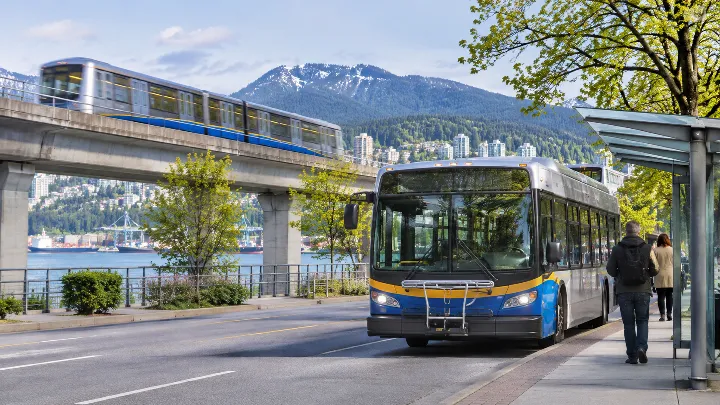
BC NDP MLA Bowinn Ma is urging Premier Lorne Doerkson’s new Conservative-led government to fund TransLink’s proposed Metrotown–North Shore bus rapid transit (BRT) line. She sees the BRT as a step toward eventually bringing SkyTrain across Burrard Inlet. In a Nov. 19 social media post, Ma, the re-elected North Vancouver–Lonsdale MLA and former minister of infrastructure, said funding talks were underway before the provincial election was called. She urged Surrey–White Rock MLA Trevor Halford, the new minister of transportation and infrastructure, to reach an agreement with TransLink.
In recent years, Ma identified both street-level light rail transit (LRT) and SkyTrain as possibilities after an intermediate BRT step. Her post last week went further, naming SkyTrain as her preferred permanent, long-term rapid transit solution for the North Shore. She said the goal is a high-capacity, fixed-link rapid transit service, while critical mobility improvements continue in the meantime. Ma urged the new government to conclude funding discussions with TransLink and get BRT construction underway, then turn its attention to the “big prize”: SkyTrain.
TransLink and North Shore municipalities are still studying long-term options for a crossing. Ma helped launch that work in 2018, chairing a group that brought together different levels of government, First Nations, TransLink and the Port of Vancouver to address congestion. In a 2019 opinion article for Daily Hive Urbanized, she said the 2020 launch of the R2 Marine Drive RapidBus serving the North Shore was a step toward a future rail rapid transit project.
Since September 2026, passengers have been able to travel from Park Royal in West Vancouver to Metrotown in Burnaby on a single RapidBus ride, without a transfer. TransLink extended the R2 RapidBus beyond Phibbs Exchange via the Ironworkers Memorial Bridge, Hastings Street and Willingdon Avenue. The route is now called the R2 Marine-Willingdon RapidBus. It gives passengers direct access to the BCIT Burnaby campus and connections to SkyTrain’s Brentwood Town Centre and Metrotown stations.
The extended R2 route is showing early signs of strong ridership. TransLink previously told Daily Hive Urbanized it recorded about 434,000 boardings from Sept. 8 to Oct. 7, 2026, up 160 per cent from the comparable period after Labour Day in 2025, when the route served only the North Shore. Average weekday boardings rose from about 6,000 to more than 16,000. Some of the increase came from passengers who previously used the No. 130 Kootenay Loop/Phibbs Exchange route or the cancelled No. 222 Willingdon Express.
The proposed 21-kilometre Metrotown–North Shore BRT line would upgrade the R2 with dedicated bus lanes, traffic signal priority at intersections and large stations resembling LRT stations. Buses would still share the Ironworkers Memorial Bridge with other traffic. TransLink expects to decide in 2027 whether the route to Brentwood Town Centre will use Hastings Street and Willingdon Avenue or Boundary Road and Lougheed Highway. Burnaby Heights businesses have raised some opposition over the potential loss of curbside parking on Hastings Street to make room for bus lanes. TransLink has funding for design and planning, but still needs to secure significant construction funding. Ma told Halford the priority work should not die with the BC NDP, saying the North Shore is counting on him.
TransLink has not released a more precise construction cost estimate for the proposed line. Several years ago, it estimated each of its first three BRT lines would cost between $250 million and $300 million. Its estimate for the 19-kilometre King George Boulevard BRT, the region’s first such project, has since risen to about $700 million. The line runs along King George Boulevard between Surrey City Centre and Semiahmoo Town Centre in South Surrey.
In September 2020, the provincial government released a preliminary study by engineering firm Mott MacDonald identifying five possible rapid transit routes across Burrard Inlet. Engineers mapped the routes using SkyTrain’s limits on the grades its trains can climb and how tightly they can turn. Building on that study, North Shore Connects, a partnership of the three North Shore municipalities and First Nations, examined two routes from Park Royal across the Second Narrows in 2021. One would follow Willingdon Avenue through Brentwood and past BCIT to Metrotown, following the R2 route and informally known as the “Purple Line.” The other would follow Hastings Street to Waterfront Station in downtown Vancouver and is informally called the “Gold Line.” Using SkyTrain as a benchmark, the study estimated that, depending on the route, the line could generate 50,000 to 60,000 additional transit trips daily by 2050. About three-quarters of those trips would otherwise be made by private car.
A 2023 study by engineering firm McElhanney for the District of North Vancouver estimated that SkyTrain could travel from Park Royal to Metrotown in 23 minutes, compared with 47 minutes for street-level LRT. It projected about 120,000 daily SkyTrain boardings by 2050, compared with 100,000 on LRT. Currently, the R2 Marine-Willingdon RapidBus takes 60 to 80 minutes end to end between Park Royal and Metrotown, depending on the time of day, direction and traffic. Congestion on the Ironworkers Memorial Bridge, where buses share lanes with other vehicles, accounts for much of the variation. TransLink previously estimated that upgrading the R2 to the proposed BRT line could reduce end-to-end travel time to 60 minutes during peak periods.
The Conservatives’ election platform promised support for SkyTrain, BRT, RapidBus, bus and ferry expansion where population and ridership justify it. Doerkson has made a specific SkyTrain extension commitment in Surrey, promising to work with the federal government to extend the Expo Line south from Surrey City Centre along King George Boulevard to Newton Town Centre. After he and his cabinet were sworn in last week, he reiterated the commitment.
The Ironworkers Memorial Bridge, which opened in 1960, was the last vehicle bridge built across Burrard Inlet. The last major new passenger link opened in 1977, when SeaBus began service between downtown Vancouver and Lonsdale Quay. A single blocked lane on either the Lions Gate Bridge or the Ironworkers Memorial Bridge can delay drivers and bus riders for hours. The congested, unreliable crossings also contribute to housing affordability and economic challenges on the North Shore. Both bridges are important routes for travellers heading to the BC Ferries Horseshoe Bay terminal for sailings to Vancouver Island and the Sunshine Coast, as well as for those taking the Sea to Sky corridor to Squamish, Whistler, Pemberton and the B.C. Interior beyond.