 Vancouver
METRO VANCOUVER NEWS
Aldergrove radio station’s future becomes an issue in Township election debate
Candidates disputed whether Langley Strong’s platform could lead to development on federal land near Aldergrove, including forest and wetlands at the former military radio site.
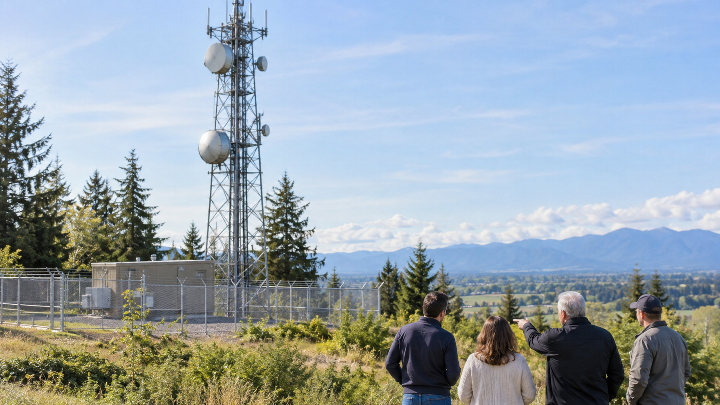
The future of federal land near Aldergrove that has long served as a military facility became a key issue at an all-candidates meeting for Township council contenders on Monday, Oct. 5. Progress For Langley members accused their Langley Strong opponents of wanting to pave over a large stretch of mostly wild land. Langley Strong councillors said they had no such plan.
The roughly 1,200-acre parcel north of Aldergrove includes forest and wetlands and is part of Naval Radio Station Aldergrove. Built during the Second World War as the receiving station for a large radio system used to communicate with Royal Canadian Navy ships in the Pacific, it once hosted a large active base. The transmitting station was in Sumas. As technology advanced, the number of Canadian Forces members was reduced and on-base housing was eventually removed. The transmitting equipment remains in use, and local cadets also use the site.
The largest portion of the federal lands is a 900-acre site between 264 Street and 272 Street, extending from 48 Avenue in the north to 36 Avenue in the south. The debate was prompted by a two-sentence pledge in Langley Strong’s platform. It says that, if elected, the slate would open discussions with the federal government about the long-term future of Department of National Defence land south of the 264 Street/Highway 1 interchange. It would also investigate dedicating part of the land to industrial space to grow Langley’s economy and tax base, create more manufacturing jobs for Canadians and respect the environment.
The base had been mentioned in passing in previous debates, but the issue became a direct exchange on Oct. 5 after Progress For Langley candidate Michael Pratt answered a question about protecting local ecosystems. Pratt said candidates had to be careful about what they say and write on the issue. He said he was frustrated to read platforms proposing to fill in and develop the radio station’s 900 acres, which he described as the headwaters of the Salmon River and a site containing forest and wetlands.
Langley Strong’s Lauren Chalus responded that the slate’s policy was not to simply fill in the entire site. She said the site has important wetlands, and that riparian setbacks and provincial legislation would apply. Mayoral candidate Jay Lundgren also defended Langley Strong, saying the slate wanted to know the other candidates’ intentions for the land. He said that did not mean removing it from the Agricultural Land Reserve (ALR) or developing it, and that Langley Strong’s platform had never said that.
Incumbent Mayor Eric Woodward said a developer had approached him a year and a half earlier with a plan to ask the federal government to remove the land from the ALR for development. Woodward said he personally declined to support it. Calling it “an outrageous plan,” he said he did not want to see land removed from the ALR or discuss that proposal. He said the discussion should instead be about creating jobs closer to home on land that is not farmland.
Virtually every candidate said at some point that farmland should remain farmland and the ALR should be protected. All candidates also agreed, in response to a question about increasing Aldergrove’s tree canopy, that efforts to add trees to public and private land should continue. Other topics included protecting Bertrand Creek, supporting arts for students and young people, and truck parking in rural areas.
Almost all candidates attended. Langley Strong’s Teresa Townsley was involved in a car crash earlier that day and could not attend. Progress For Langley’s Rob Rindt was also absent.