 Vancouver
METRO VANCOUVER NEWS
Vancouver council cancels Serve Robotics food delivery pilot before launch
Vancouver City Council has directed staff to stop work on a planned six-month Serve Robotics delivery trial in downtown Vancouver and Kitsilano. The pilot had not begun and still needed provincial approval to let the robots use sidewalks and cross streets. Councillors and advocates cited accessibility, public space and
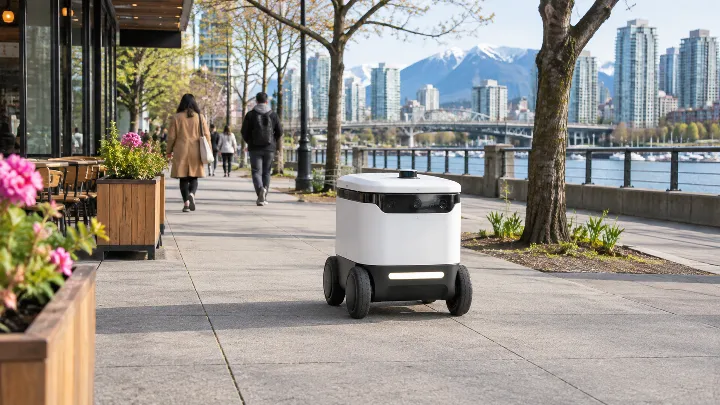
Vancouver City Council has directed staff to abandon a planned food delivery robot pilot, citing concerns about commercial use of public space, accessibility barriers and local employment. The decision was included in a motion by OneCity Coun. Lucy Maloney approved last week, reversing an earlier decision by the previous ABC-led council. ABC Coun. Mike Klassen cast the only vote against Maloney’s overall motion. Klassen’s own motion, approved in May 2026, had authorized a six-month trial with Serve Robotics in downtown Vancouver and Kitsilano, initially targeted for fall 2026.
City staff confirmed during last week’s meeting that the pilot had not started. Provincial approval was still required to allow wheeled robots to cross streets and travel on sidewalks to deliver restaurant food to customers. The change would involve amending the province’s 2023 Motor Vehicle Amendment Act to include autonomous delivery robots in the definition of designated micro-utility devices. The robots keep food in a locked compartment that customers can open using a smartphone app such as Uber Eats.
Maloney said the city could learn from jurisdictions that have tested delivery robots without putting them on Vancouver’s sidewalks. She raised concerns about accessibility, cameras on the devices and competition for pedestrian space. She also questioned whether replacing some delivery vehicle trips with robots would simply move traffic from roads to sidewalks. At the meeting, she said the pilot had serious problems and could have been examined through a desktop study of other jurisdictions. If robots reduce road traffic, she asked, where does that traffic go? Her concern was that it would add to already congested sidewalks.
Ana Booth, executive director for B.C. and the Yukon at the Canadian National Institute for the Blind (CNIB), supported those concerns. She told council that another unpredictable obstacle could make everyday travel harder for people who are blind, deafblind or have low vision. Booth said CNIB is not opposed to new technology and relies on it to support independence. But she said any future project should include accessibility, equity, safety and the independence of different communities in its planning and design, with people who have lived experience involved in shaping the project and its results. She said this approach could help projects succeed without relying on complaints, challenges and accidents after a pilot is in place. Margie Sanderson, director of organizing at Vision Zero Vancouver, also supported stopping the pilot work. She pointed to narrow sidewalks and missing curb ramps in the proposed trial area, saying the city should improve the pedestrian network before introducing robots there.
Serve Robotics vice-president of policy Vignesh Ram urged council to pause the reversal and hear about work already completed. He said the company had spent years engaging with municipal officials, neighbourhood groups, business associations and disability advocates, but had not yet had the chance to brief the newly elected council. Ram said Serve was not asking Vancouver for a permanent commitment. A trial, he argued, would let the city set conditions, gather public feedback and assess the service before deciding its longer-term future. He said the small electric robots could help local restaurants reach nearby customers and reduce short car trips.
Addressing employment concerns, Ram pointed to possible jobs in mapping, operations and robot maintenance. He said Serve already employs people in Vancouver and expects to hire more locally. He described the positions as high-quality, entry-level technology jobs particularly suited to veterans transitioning to civilian life and young people leaving school with robotics experience. Ram also said input from disability advocates had informed the robots’ design and behaviour around pedestrians, and that the company shares information with cities about missing curb ramps and other infrastructure problems.
Serve Robotics, founded in 2021 and based in the San Francisco Bay Area, was co-founded by Ali Kashani. Kashani earned a bachelor of science in computer engineering and a PhD in robotics from the University of British Columbia (UBC). According to the company’s website, Serve has deployed more than 2,000 robots, operates in 44 cities across 14 U.S. states, has a delivery completion rate of 99.8 per cent and works with more than 4,000 merchant partners. The company became publicly traded on the Nasdaq in 2024.
The Greater Vancouver Board of Trade (GVBOT) also urged council to speak with the company before cancelling the pilot. Vice-president David van Hemmen cited potential benefits for restaurants and local employment, as well as the opportunity to identify accessibility problems. He stressed that a trial would not grant permanent permission to operate. Van Hemmen said a meeting could clarify the company’s proposal, including its potential to create low-barrier jobs and provide useful accessibility data. He described the project as a chance to test Canadian technology locally and potentially help it scale if successful, noting that it was founded by Vancouver entrepreneurs and a UBC alumnus.
Jairo Yunis, policy director at the Business Council of British Columbia, called for a deferral and a briefing from city staff. He argued that a controlled trial could address questions about public space, accessibility and employment. Reversing course before that work was complete, he warned, could undermine business confidence. Yunis said Vancouver competes with other cities for companies’ investment, construction and hiring decisions, and that confidence depends in part on decisions based on evidence and a fair hearing for new ideas. He said a new council’s early decisions signal how its four-year term may unfold, and investors would read the decision as a signal Vancouver does not need right now.
Klassen said he was disappointed that council was abandoning the six-month trial. He argued that investigating safety concerns should be a central purpose of testing the technology. He said refusing even to pilot a programme sent a concerning message to the technology innovation sector and was not a good signal at a time of rapid technological change.
The debate comes amid Vancouver’s history of adopting new transportation technology. Metro Vancouver was among the last major North American markets to welcome ride-hailing services; Uber and Lyft launched in Vancouver in January 2020 after years of political debate and regulatory delays, by which time the platforms were common in many major cities elsewhere. Waymo plans to launch its first Canadian driverless taxi service in Toronto in 2028. The Alphabet-owned company announced the plan in October 2026, with street mapping and tests involving trained drivers to come before fully driverless passenger trips.
Maloney’s motion also revived plans for 30 km/h or 40 km/h speed limits on selected major streets, halted work to align Vancouver’s Building By-law with the provincial B.C. Building Code, and stopped consideration of a two-way bike lane on West 10th Avenue near Vancouver General Hospital. Staff were also directed to explore restoring policies that encourage local hiring and purchasing and reduce private car use in new developments. They were told to resume work on using business licence fees to encourage battery-electric vehicle chargers at gas stations and large commercial parking lots.
The motion was one of 11 broad member motions put forward by Orr, Fry and Maloney and approved at the same meeting. The motions were intended to complete items carried over from the previous council term, implement priorities promised by the new leadership and reverse some ABC policies.