 Vancouver
METRO VANCOUVER NEWS
Canada and the Philippines conclude free trade agreement talks, aiming for 2027 signing
Prime Minister Mark Carney and Philippine President Ferdinand Marcos Jr. signed a document formally ending negotiations for a bilateral free trade agreement. Ottawa aims to sign the deal next year, after talks that began just over a year ago.
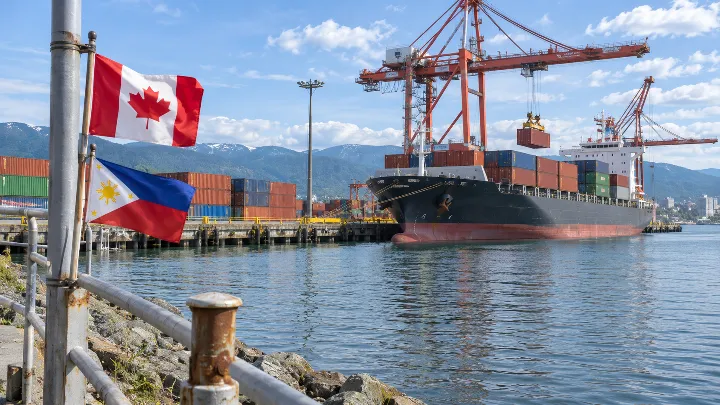
Prime Minister Mark Carney and Philippine President Ferdinand Marcos Jr. have concluded negotiations for a free trade agreement, which is expected to be formally signed next year. In Manila, Carney told Marcos: “A ship that stays in the harbour is safe, but that’s not what a ship is for. And it takes a leader to take the ship out of the harbour into choppy waters and reach a destination.” He then said Marcos had done that in their relationship.
The two leaders met on the sidelines of the Association of Southeast Asian Nations (ASEAN) summit and signed a document formally ending negotiations for the Philippines-Canada Free Trade Agreement. Talks began just over a year ago, and Ottawa aims to sign the actual deal next year. The signing took place on Saturday in Manila, which was Friday evening in Canada.
The ASEAN summit involves 20 heads of government, including guests from outside the region such as U.S. President Donald Trump and Brazilian President Luiz Inacio Lula da Silva. Southeast Asia is one of the world’s fastest-growing economic regions, and the ASEAN bloc includes nearly 700 million people.
Canada is also pursuing a broader trade agreement with ASEAN, which includes the Philippines and 10 other countries, including Thailand. Ottawa says trade between Canada and ASEAN countries totalled $52.3 billion last year, up one-fifth from the previous year. The bloc is central to Carney’s goal of doubling exports to countries other than the U.S. by 2035.
Vina Nadjibulla, co-founder of the Centre for Strategic Statecraft, said the ASEAN summit, along with two other regional summits this week, gives Carney a chance to reinforce Asia’s importance to Canadians. She said much of his diplomacy in recent months has focused on Europe, understandably, but Canada also needs to remind people that it is a Pacific nation with an Indo-Pacific strategy and that the region is critical to the country’s prosperity.
Carney signed a trade deal with Indonesia last autumn. This summer, he signed a strategic partnership agreement with the Philippines that called for greater labour mobility and climate-resilience projects between the two countries. The Philippines has a population of more than 110 million.
In 2025, bilateral merchandise trade between Canada and the Philippines totalled $3.4 billion. Canada exported mineral ores, meat, cereals, fertilizers and aircraft, and imported cooking oils, leather and rubber products from the Philippines. The two countries have been discussing a bilateral trade deal since 2015. Carney and Marcos restarted those efforts a year ago.
During consultations, corporations broadly supported the deal as a way to increase trade, while civil society groups raised concerns about the Philippines’ record on the environment, labour and human rights. The work stemmed from the government’s Indo-Pacific strategy, released four years ago. Foreign Affairs Minister Anita Anand said a year ago that she had asked officials to update the strategy to better align with Carney’s priorities, including doubling non-U.S. exports by 2035 and making Canada an energy superpower.
This weekend’s ASEAN summit comes as countries in the region contend with heavy smoke from Indonesian wildfires linked to climate change and palm-oil extraction. It also takes place amid rising geopolitical and economic competition between the United States and China. Nadjibulla said that competition has been a factor at most ASEAN summits in recent years, particularly in discussions involving semiconductors, critical minerals and tariffs.
“Canada wants to be there as an alternative, as a partner that is similar to Japan, Australia, and others who give more options to ASEAN, so that they’re not stuck between these two superpowers,” she said. Carney is also pushing Pacific Rim countries to trade more with the European Union and positioning Canada as a bridge between larger markets seeking to preserve the rules-based trading system that American and Chinese coercion is undermining.