 Vancouver
METRO VANCOUVER NEWS
Kareem Allam’s Vancouver Liberals accuse the mayor of proposing a downtown “prison”
Allam’s party launched its “No Vancouver Prison” campaign against ABC Vancouver’s proposal to use part of the old St. Paul’s Hospital campus for secure mental health and addictions care, ahead of two non-binding questions on Vancouver’s Oct. 17 ballot.
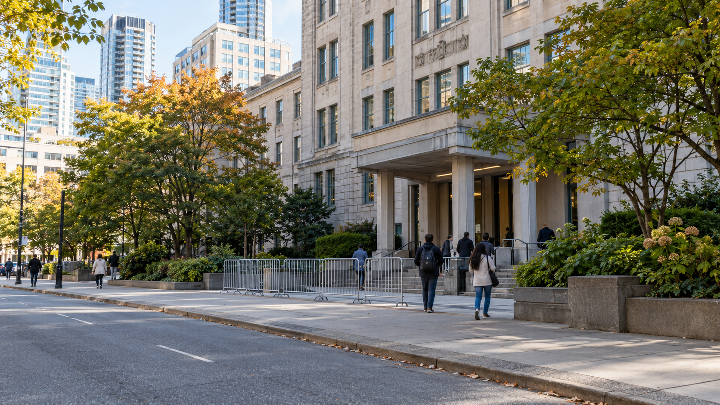
Mayoral candidate Kareem Allam and his Vancouver Liberals party launched their “No Vancouver Prison” campaign today, opposing Mayor Ken Sim and ABC Vancouver’s proposal to convert part of the old St. Paul’s Hospital campus on Burrard Street into a temporary facility for voluntary and involuntary mental health and addictions treatment. Allam characterized the proposal as creating a prison in Downtown Vancouver’s West End. He is urging voters to oppose both non-binding advisory public safety plebiscite questions on Oct. 17, the date of the civic election.
The second question asks whether the City of Vancouver should formally request that the provincial government convert portions of the old hospital, or another similar site, into a secure medical facility with acute voluntary care and more than 100 involuntary care beds for people who pose a serious risk to themselves or others because of severe substance use and mental health disorders. The question allows another suitable site to be considered, but no alternative location has been identified. Allam said he supports involuntary care in some circumstances but opposes using the old hospital because it is centrally located on the Downtown Vancouver peninsula and adapting it could carry high capital costs, even temporarily. Asked where else a facility of that scale could go, he said he could not identify an appropriate site in Vancouver. He repeatedly called the proposed facility a prison, arguing that keeping patients from leaving would require security staff and a purpose-designed building.
ABC envisions using part of the old campus as a temporary secure medical facility for at least several years after Providence Health Care moves its operations to the new hospital at False Creek Flats, which is expected to begin receiving patients in 2027. The Burrard Street campus was sold to local developer Concord Pacific for eventual high-density, mixed-use redevelopment, with the proceeds helping fund the new hospital. But amid economic challenges and weak housing demand, construction could still be a decade away. Concord Pacific has not prepared a master plan or filed a rezoning application. ABC says the gap creates an opportunity for interim health-care use lasting years. Concord Pacific has indicated it would discuss temporary uses with governments. The old hospital can already accommodate more than 70 beds for this specialized care. The developer has also extended Providence Health Care’s lease beyond 2027 for interim researcher space; the new research building under construction at False Creek Flats is not expected to be completed until 2029.
This summer, Premier David Eby announced plans for two new involuntary-care facilities elsewhere in B.C., converting a former long-term residential addiction recovery facility in Surrey and a former youth corrections facility in Prince George. The provincial government will spend $149 million renovating and expanding the properties into modern secure treatment facilities, adding 132 involuntary-care beds in total. Phased openings are projected from late 2027 to late 2028.
Allam also suggested the proposal could amount to a developer “bailout.” Concord Pacific bought the 6.6-acre property for about $1 billion in 2020, before the current real estate downturn, and Allam said market conditions have since deteriorated sharply. He said the site near Davie Village and the Central Business District should instead be used for housing, commercial space and public spaces. In his view, a large secure-care institution there would undermine efforts to bring more positive activity to Downtown Vancouver. ABC’s proposal has also received strong public support from Downtown Van, the local business improvement association for the Central Business District and Granville Entertainment District; the BC Schizophrenia Society; clinical psychologist and addictions researcher Dr. Julian Somers; and some local businesses and recovery workers.
Dr. Moira Stilwell, a physician and former BC Liberal MLA and cabinet minister who is running for City Council with the Vancouver Liberals, said she has worked at St. Paul’s Hospital for more than 30 years and has serious concerns. She cited a previous Providence Health Care review that identified major earthquake vulnerabilities in parts of the old campus. Those concerns were a driving factor in the decision to move the hospital to a modern, purpose-built campus at False Creek Flats. Stilwell described an aging complex with buildings from different periods, outdated equipment and infrastructure, and a need for continual repairs. She said it is becoming increasingly expensive to operate and maintain, raising concerns about both conversion costs and the ongoing cost of running a secure medical facility there. She also argued that the layout is poorly suited to secure psychiatric treatment and cannot provide the share of single-patient rooms sought in modern facilities.
“Safe units are built from the ground up with clear sight lines, safe fixtures, private rooms and calm spaces to de-escalate. Modern hospitals aim for most rooms to be single occupancy, and of course we can’t do that here,” Stilwell said. “Involuntary care is serious medicine. If we take away someone’s liberty to treat them, we owe them a building that’s fit for care and St. Paul’s is not one of them.”
Allam’s alternative includes negotiating what he called a new “Vancouver Accord” to bring municipal, provincial and federal governments together on a joint strategy for mental health, addiction, housing and public safety. He wants to expand the four-pillar approach into a six-pillar plan, with youth mental health and housing as separate priorities. Allam said more resources should reach young people before their problems worsen. He also argued that enforcement and harm reduction have received too much attention at the expense of other needed services. His priorities include beds where people can stabilize, longer-term treatment, housing for people in recovery and involuntary care for those who need it.
Allam criticized the first plebiscite question, which asks whether voters support strengthening Vancouver’s laws to prohibit open-air use of heroin, methamphetamine, fentanyl and crack cocaine in public spaces. He argued that police already have enforcement powers and Sim should press for their use without seeking another public mandate first. ABC says a vote in favour would give the City an explicit political mandate to introduce new enforcement measures against public hard-drug use. Its staunchest critics continue to question whether its previous enforcement-based efforts to address crime and public disorder had sufficient public backing.
In spring 2023, Sim and ABC moved to dismantle a long-running homeless encampment along Hastings Street in the Downtown Eastside. Dense clusters of tents and makeshift structures extended into curbside lanes and completely blocked sidewalks and building entrances. Numerous propane tanks added to safety concerns. Fire and police officials supported the removal, citing serious safety risks and concerns about rampant crime and other illicit activity associated with the encampment’s growth. The operation drew fierce opposition, particularly from activists, some of whom protested and tried to physically obstruct the work. Allam had also criticized the removal.
Voters will receive two ballots on Oct. 17. One will be used to choose the mayor, city councillors, Park Board commissioners and School Board trustees, and to answer the capital plan plebiscite questions. The second will contain the two public safety plebiscite questions. A week later, on Saturday, Oct. 24, voters will return to the polls for the provincial general election to elect the MLA in their riding. The Vancouver Liberals are not affiliated with the federal or provincial political parties of the same name.