 Vancouver
METRO VANCOUVER NEWS
Telus exits Westbank’s two Vancouver AI data centre projects
Telus has left two planned Vancouver data centre projects, but Westbank says both will proceed with a new, unnamed partner. One proposal still awaits public consultation, while council is set to consider a motion on tighter data centre oversight.
Telus is no longer partnering with local developer Westbank on two artificial intelligence (AI) data centres in Vancouver. Both companies confirmed Telus’s departure. Westbank says it intends to proceed with a new partner whose identity has not been announced. A Telus spokesperson said the company had decided against co-developing the previously announced facilities. A Westbank spokesperson confirmed Telus was no longer a partner and said the companies had enjoyed a successful relationship for more than a decade and hoped to continue working together in other capacities. The projects are part of Prime Minister Mark Carney’s Enabling Large-Scale Sovereign AI Data Centres initiative.
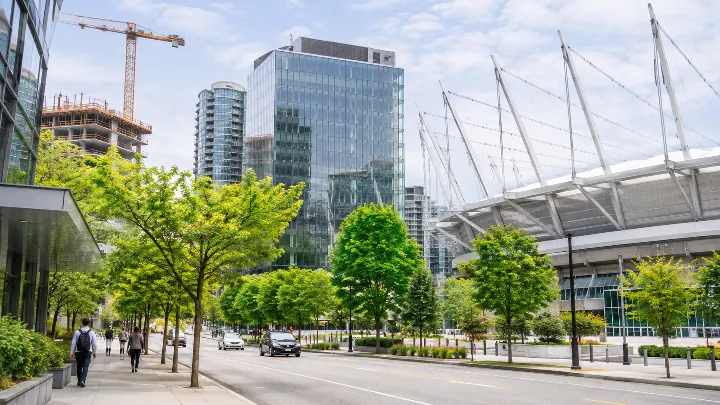
The projects were formally announced about six months ago. One is planned for 150 West Georgia St., on Beatty Street beside BC Place Stadium in downtown Vancouver; the other is proposed for the existing M3 office building at 111 East 5th Ave., near Main Street in the Mount Pleasant Industrial Area. Telus says it is advancing other plans to expand Canadian AI computing infrastructure, including an expansion of its existing Kamloops facility to 20 megawatts (MW) by the end of 2028. Data centre capacity is typically measured in MW because available electricity and cooling capacity largely determine how much computing equipment a facility can operate. Telus is also considering development partners and locations elsewhere in B.C. and is working with provincial and federal governments to align its plans with the federal initiative. A Telus spokesperson attributed the expansion to growing demand at existing facilities and said more details about the company’s strategy would be released in the coming months. The spokesperson said Telus remains committed to Canada’s digital sovereignty and to building secure, sustainable, high-performance computing infrastructure to help the country compete in the global AI economy.
The May 2026 Telus-Westbank announcement presented the two Vancouver projects and the Kamloops expansion as a three-site network for Canadian-controlled computing infrastructure serving businesses, post-secondary institutions, researchers, public institutions and governments. The federal government has identified a national security need for such “sovereign” facilities, a strategy to keep AI computing infrastructure and sensitive data in Canada and under Canadian control, reducing reliance on foreign providers. Telus said at the time that it had secured an initial 85 MW of electricity from BC Hydro for the network, with combined capacity expected to exceed 150 MW by 2032. Both Vancouver projects were expected to be ready before the end of this decade. The strategic shift follows the departure of longtime Telus CEO Darren Entwistle at the end of June 2026. Victor Dodig, formerly CIBC’s CEO, replaced him.
The two Vancouver proposals take substantially different approaches. In Mount Pleasant, Westbank wants to convert M3, a six-storey office building in its Main Alley campus that previously housed part of Hootsuite’s headquarters, into a data centre. The rezoning application would permit data storage throughout the office floors and convert underground parking levels to supporting equipment and other facilities. A restaurant would be added at ground level, with no increase to the building’s overall size. Westbank’s project website describes M3 as a 26 MW facility.
The Mount Pleasant proposal remains subject to further public consultation. On July 21, the previous Vancouver City Council returned the rezoning application’s referral report to City of Vancouver staff, removing it from the July 23 public hearing agenda and asking for more public consultation after the October civic election. The city has since announced a formal consultation period for the M3 application from Dec. 2 to 15, 2026. The source’s image captions identify the existing M3 office building at 111 East 5th Ave., a 2025 conversion concept and a rendering of the data centre at the Main Alley campus; one concept caption gives the address as 111 East 6th Ave., while the article identifies the project site as 111 East 5th Ave.
Downtown, a new 10-storey AI data centre is planned for 150 West Georgia St., a site previously designated for a major office building. Data centre uses are already permitted there, and a 2023-approved rezoning text amendment allows bulk data storage, so a new rezoning application is not required. The project is designed to integrate with Creative Energy’s steam plant beneath the same site. Major construction is underway to expand and electrify the plant, moving away from natural gas boilers used for decades. Its below-grade structure on Expo Boulevard will form part of the foundation for the planned data centre above Beatty Street.
Creative Energy’s bulk steam heat and extensive underground pipe network already provide space heating and hot water to more than 200 buildings across the downtown peninsula, with about 50 million square feet of total floor area. Heat recovered from the data centre would help produce steam to heat those buildings, greatly reducing the energy—electricity and/or natural gas—needed to produce steam heat. The May 2026 announcement also raised the possibility of connecting the M3 facility to the city’s Neighbourhood Energy Utility. Source image captions show the existing Creative Energy steam plant at 150 West Georgia St. (720 Beatty St.) and a 2026 concept of the proposed data centre.
The two data centre projects have prompted protests and rallies over the past half-year. Opponents have cited electricity and water consumption, noise, the use of centrally located urban land, and whether the facilities would deliver enough lasting local jobs and public benefits. Some critics have also connected their opposition to broader economic concerns about AI replacing workers.
Vancouver’s newly elected council may bring closer scrutiny to data centre projects. On Nov. 18, council is scheduled to consider a motion from Coun. Lucy Maloney seeking stronger oversight. It would explore requiring applicants to commission independent third-party assessments of potential water use, emissions, noise, heat and employment impacts before rezoning or permitting. The motion would also examine a dedicated business licence requiring annual public disclosure of water and electricity consumption and noise levels, along with possible fees or contributions to secure public benefits. It calls for further policy work by city staff and would not itself put those requirements into effect.
A spokesperson representing the two Vancouver projects said Westbank supports Maloney’s motion to study computing infrastructure and how it can be implemented thoughtfully. The spokesperson said the company shares her objective of helping Vancouver lead in highly sustainable, net-positive computing. The projects will proceed under a new partnership, with more details to come, the spokesperson said, adding that there would be further updates on an initiative to create sovereign, net-positive computing infrastructure for Canada.