 Vancouver
METRO VANCOUVER NEWS
Vancouver council halts West 10th bike lane redesign despite hospital safety concerns
Vancouver City Council has stopped planning a proposed two-way bike lane beside Vancouver General Hospital. Vancouver Coastal Health says the current layout creates conflicts at hospital access points, while city staff say a broader safety review will continue.
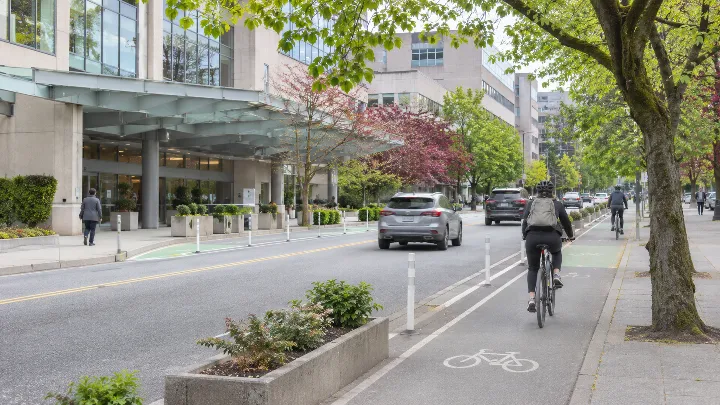
Vancouver City Council has stopped planning a proposed two-way bike lane on the north side of West 10th Avenue beside Vancouver General Hospital (VGH). The option would have replaced separate one-way protected lanes on both sides of the street with a single two-way lane on the north side, including the eastbound lane immediately outside VGH’s Emergency Department. Vancouver Coastal Health (VCH) strongly supported the redesign, citing potential conflicts among cyclists, patients, emergency vehicles and other traffic accessing the hospital. The health authority raised concerns about the lane’s design during the city’s initial planning roughly a decade ago and continues to question its safety after years of use. The first section, outside the Emergency Department, was completed in 2018.
The decision was part of a wide-ranging member motion by OneCity Coun. Lucy Maloney that council approved last week. The broader motion passed, with ABC Coun. Mike Klassen casting the only vote against it. In July 2026, the previous ABC-led council had directed city staff to continue discussions with VGH about the conflicts, including the possibility of a north-side two-way bike lane and one-way vehicle traffic on West 10th. At the meeting, hospital representatives urged the new, left-leaning council to let the planning continue.
Dr. Vinay Dhingra, a critical care doctor and VGH co-senior medical director, said the current layout creates major conflicts and safety risks for hospital operations. He said the cycling infrastructure on West 10th conflicts with pedestrians, cyclists and vehicles at several key access points, including the Emergency Department, equipment loading bays and service driveways. Those locations see complex, unpredictable movements involving first responders delivering life-saving care, patients with mobility challenges accessing services, and vehicles supporting essential hospital operations. Dhingra also said VGH’s planned major campus expansion and growth in health-care operations add to the need for safer bike lanes. The current configuration, he said, presents serious risks and does not meet the needs of the hospital today or as it grows. He asked council, on behalf of himself and VCH, to reject the motion and allow VGH and city staff to examine all viable options and make recommendations based on technical expertise, health-care requirements and evidence. He said they wanted scientific analysis to guide the work.
Shelly Fleck, VGH’s director of surgical services and VCH’s director of strategic initiatives, also said the hospital wanted to examine a different arrangement while keeping cycling infrastructure on West 10th. She said work with city staff had been underway since June 2026, including gathering information about conflicts, near misses and collisions involving ambulances. She asked council to let the planning finish so recommendations could account for data, hospital operations and street design. Fleck said the hospital supports cycling and is not asking to remove the bike lane. It wants to move from one-way to two-way cycling and is also willing to examine traffic flows. West 10th currently carries two-way vehicle traffic; if the bike lane became two-way, the hospital would consider one-way vehicle traffic as well. She said VCH and city staff have identified critical conflict areas, including near misses and collisions involving ambulances and other hospital vehicles, visitors, health-care staff, cyclists, scooters, e-bikes and pedestrians. They have completed extensive planning and modelling and are working through complex design, operational and safety questions. The hospital’s priority, Fleck said, is safe access for all patients, staff, medical staff and visitors without disrupting patient care.
Some cyclists and cycling advocates offered a sharply different view, considering the issue primarily from a cyclist’s perspective. James Rankin said his family relies on bikes and frequently travels through the hospital area. The separated lanes on West 10th feel very safe to them, he said, and they do not want them changed. Rankin worried drivers approaching from streets to the north would not expect eastbound cyclists coming from their right. He said his family would choose to ride with vehicle traffic rather than use the proposed two-way lane on the north side. He argued the redesign could increase conflict between cyclists and drivers and discourage cycling. With the impacts of climate change visible every day, he said, streets should feel safer so more people choose bicycles over cars for trips within the city.
Margie Sanderson, organizing director for Vision Zero Vancouver, also supported stopping the redesign. She argued it would consume city staff time and limited cycling infrastructure funding without improving safety. After hearing public speakers, Green Coun. Stephanie Smith asked about the sharply different safety assessments and whether stopping the two-way option would also end the review of safety data and discussions with VCH. City staff said the existing configuration is effective and the broader West 10th Avenue safety review would continue.
Maloney defended keeping the current layout, saying it was designed after extensive consultation in the 2010s and that staff time and funding would be better spent on other improvements. She said she respects VGH’s work and strongly supports its expansion plans being fast-tracked, but called the bike lane planning an unequivocally poor use of staff time. She suggested rebuilding the segment questioned by the hospital and health authority could cost $20 million. Maloney said inconvenience to motorists entering and leaving parkades is different from statistical safety, and that ICBC statistics show the current configuration is safer than before it was installed.
Klassen opposed the broader motion, arguing significant policy reversals should be considered individually. He emphasized the hospital’s concerns and said he hoped for a solution that addresses the cited risks while keeping West 10th Avenue an active cycling route. He said he understood that VCH, as the applicant, had borne much of the cost to date and had repeatedly maintained that the risks were high. He thanked health authority representatives for taking part in the discussion and said he hoped council could find a way forward that addresses those risks while preserving the route for cycling.
The bike lane decision was one part of Maloney’s approved motion. It also halted a planned sidewalk food-delivery robot pilot, revived the prospect of lower speed limits on selected major streets, and stopped work on aligning Vancouver’s Building Bylaw with the provincial B.C. Building Code, which is followed by all other municipal governments. The motion directed staff to explore restoring local hiring and purchasing requirements for major developments and policies encouraging alternatives to private cars in new developments. It also resumed work on increasing business licence fees intended to encourage gas stations and large commercial parking lots to install electric-vehicle charging stations. The package was one of 11 member motions approved at the same meeting from Maloney, Mayor Pete Fry and COPE Coun. Sean Orr.
North of West 10th Avenue, the new left-leaning council is also likely to revisit the controversial idea of adding protected bike lanes on Broadway through a future member motion, following the Green Party’s election promise to add them. Broadway is a major east-west arterial on the region’s designated Major Road Network and an important ambulance route to VGH. Depending on the design, adding bike lanes could reduce the number of vehicle lanes or narrow the wider pedestrian sidewalks planned for the rebuilt Broadway.