 Vancouver
METRO VANCOUVER NEWS
B.C. Conservative and Green leaders challenge David Eby’s record in election debate
Lorne Doerkson and Emily Lowan pressed B.C. NDP Leader David Eby on his government’s record during the campaign’s only televised debate on Oct. 14. The leaders clashed over taxes, housing, health care, Indigenous relations and public safety ahead of the Oct. 24 provincial election.
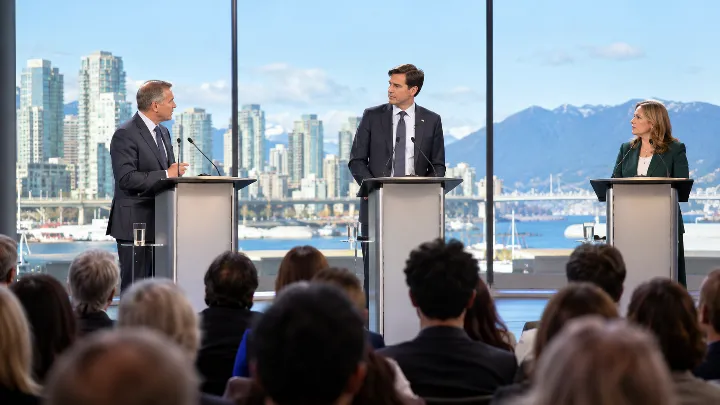
B.C. NDP Leader David Eby faced repeated challenges from Conservative Party of British Columbia Leader Lorne Doerkson and Green Party of British Columbia Leader Emily Lowan during the campaign’s only televised debate on the evening of Oct. 14. The provincial election’s general voting day is Oct. 24. The three leaders debated taxes, housing, health care, Indigenous reconciliation and public safety, offering competing explanations for the province’s problems and how they would address them. Doerkson argued that lower taxes and economic growth would improve living standards and fund services. Lowan proposed taxing extreme wealth to expand public programmes. Eby defended his government’s investments and repeatedly challenged the Conservatives to explain how they would pay for their promises. Most exchanges were between the NDP and Conservative leaders, though Lowan often joined Doerkson in pressing Eby on his government’s record and proposals.
Moderator Shachi Kurl, president of the Angus Reid Institute, opened by questioning Eby’s decision to call an early election that overlapped with municipal elections. Eby said the NDP’s narrow majority had left the government focused on surviving legislative votes, limiting its ability to make major changes. He said he wanted to do more for the province but needed a strong mandate, adding that he did not want every vote to end in a tie and needed support from British Columbians who recognized the need to respond to the moment. Doerkson accused Eby of calling the election for political advantage. The election call coincided with the Conservatives’ sudden leadership change after months of infighting. Doerkson said Eby saw an opportunity for himself, while he saw one for British Columbians.
The Conservative leader was also questioned about controversial remarks attributed to the party’s campaign director, Katy Merrifield. Kurl cited Merrifield’s description of Islam as an “abhorrent ideology.” Eby accused Heather Maahs, the Conservative candidate in Chilliwack North, of telling Surrey Cloverdale MLA Elenore Sturko that she was immoral because she is a lesbian. Sturko is now the leader of the Centre BC party. Doerkson responded by accusing B.C. Attorney General Niki Sharma, a member of Eby’s cabinet, of posting racist content on social media and challenging Eby to condemn it. He also raised former cabinet minister Selina Robinson’s allegations of widespread antisemitism within the NDP.
Kurl cited a provincial deficit of $13.8 billion for the 2026/27 fiscal year, with the government’s budget forecasts showing no meaningful turnaround through the end of the decade. The debate repeatedly returned to how the parties would finance their commitments. Doerkson promised to fully fund health care and frontline services, find savings in the bureaucracy and encourage growth in forestry, liquefied natural gas and other industries. He said a more complete financial plan would be available before voting day. Eby argued that the $5 billion in Conservative platform commitments, as he described them, combined with tax cuts and deficit reduction, would require service cuts. He defended the NDP’s proposed income tax increases for people earning more than $190,405, including a new tax bracket for incomes over $1 million, as a way to improve provincial services.
Lowan said Eby’s income-tax approach would raise too little while burdening high-earning workers. She argued that it taxed work rather than wealth and would take the greatest toll on health professionals, doctors and professors, from whom she said most of the “very minuscule” revenue would come. She outlined the Greens’ proposal for a one-time five per cent tax on fortunes of $50 million or more, followed by an annual tax. Lowan said her party projected $22.2 billion in revenue in the first year and about $5.4 billion annually thereafter to help reduce the deficit and fund affordable housing, child care and public transit. On household costs, Eby promoted measures intended to reduce some gas taxes and essential grocery prices. Lowan proposed opening 20 publicly operated grocery stores. Doerkson said his income tax changes would eliminate provincial income tax for people earning less than $32,000.
Housing added to the challenges facing Eby’s record. Doerkson called for fewer permitting obstacles, a review of building requirements and more municipal control over housing. He suggested a Conservative government would roll back at least some provincial housing requirements and mandates imposed on municipalities through NDP government legislation over the past three years. He said Victoria should not dictate what municipalities build, where they build it or how, and called for a better relationship with local governments. Lowan criticized funding cuts in the 2026 provincial budget that affected many proposed affordable housing projects; the cuts were intended in part to stabilize the government’s finances. The Greens propose building and protecting 26,000 affordable homes. Eby said 4,000 social housing units were expected to begin construction or be completed in 2026.
On health care, Eby emphasized recruiting more professionals, including tripling recruitment of American health workers, especially doctors. Lowan proposed community health centres in every riding. Asked about shifting the public system to a private or hybrid model, Doerkson said he wanted a fully public system accessible to everyone in the province, effectively rejecting some speculation that his party would pursue privatization. He also proposed a $50 million fund for emergency departments facing closure and stronger hospital security.
The future of ICBC and provincial auto insurance prompted another sharp disagreement. Doerkson defended his platform promise to change the no-fault system, saying seriously injured people and bereaved families were not receiving adequate support. He promised competitive premiums and limits on lawyers’ fees, but did not provide the guarantee Kurl requested that rates would not rise. Eby warned that restoring greater access to personal injury lawsuits under a Conservative government would increase premiums. He highlighted the NDP’s proposed three-year rate freeze.
The leaders also clashed over the NDP’s Declaration on the Rights of Indigenous Peoples Act (DRIPA) and its implications for reconciliation, economic development, investment and private property. Doerkson pledged to repeal the law, citing disputes over docks, mining claims and land tenures, while saying he would maintain partnerships with First Nations. He said the legislation had created division and that court cases were rampant. He called for a better path based on respect, relationships and partnerships, and said private property rights and existing tenures should be protected. If wealth were shared, he said, that would be welcome, but DRIPA was not solving the issue and had to be repealed.
Eby defended DRIPA as supporting Indigenous partnerships and major projects, and warned that repeal would create further conflict. He said his government was appealing court decisions to protect private property. “When you own your private property, you need to know what you have and you need to know what you can do with it,” he said. In December 2025, Eby pledged to amend DRIPA after the B.C. Court of Appeal ruled that the law gave the UN Declaration on the Rights of Indigenous Peoples (UNDRIP) immediate legal effect in provincial law, allowing courts to assess whether B.C. laws were consistent with it. He later shifted from amendments to temporarily suspending key provisions, delayed introducing legislation and ultimately shelved both options for the Spring 2026 legislative session amid strong First Nations opposition. Instead, his government agreed to work with First Nations leaders on a solution before the Fall 2026 legislative session, which has now been interrupted by the early election.
Lowan opposed repeal and called for DRIPA to apply to all B.C. laws, accusing Eby of shifting positions and the Conservatives of spreading misinformation. She said DRIPA had no bearing on private property and set rules for government to do its homework and bring legislation into alignment with B.C. laws and the UN’s minimum human rights standards for Indigenous people. During the debate, Eby was asked whether there were any undisclosed agreements to transfer land to First Nations; he did not directly address the question. About 12 hours later, on the morning of Oct. 15, local reporter Rob Shaw reported on confidential pre-election documents revealing a secret NDP plan to transfer 400 Crown parcels to First Nations.
On public safety, Eby and Doerkson supported involuntary care for people with severe mental health and addiction issues. Lowan argued that the provincial government had failed to provide enough voluntary treatment and support. Doerkson called for more police officers and support staff, expanded treatment and better management of supportive housing. He said communities needed protection from random violence while vulnerable residents needed more consistent care. He argued that police forces needed to be strengthened with more officers and support services. Eby cited efforts to target repeat offenders and combat extortion and promised involuntary care in every region. He said sites had already been identified in Surrey, Vancouver Island and the Okanagan.
Vancouver Mayor Ken Sim and his ABC Vancouver party added a non-binding public-safety plebiscite to this month’s city election ballot. One question concerns stronger enforcement against public use of hard drugs; the other calls on the provincial government to establish a secure medical treatment facility in Vancouver for people with severe mental health and addiction issues, with at least 100 involuntary-care beds as well as additional voluntary-care beds. Eby did not specifically address the plebiscite during the debate or commit to opening such a facility in the city.
Eby acknowledged that some people had been placed in housing unable to meet their complex needs. He defended involuntary care as a way to treat people unable to seek help themselves and support them in rebuilding their lives. He said social housing was not equipped for some people with serious mental health and addiction issues, and argued that a housing-first model without effective treatment had failed them. He said they needed care and support, adding that the government had been trying to recover since Riverview closed under the B.C. Liberals. Eby stressed that involuntary care should not be equated with imprisonment. His remarks differed from those of Vancouver Liberals mayoral candidate Kareem Allam, who described as a “prison” the plebiscite proposal to explore converting part of the old St. Paul’s Hospital campus into a secure treatment facility with involuntary-care beds. Eby said the facility was not a jail cell; in some cases, people were in jail because they had already been arrested, but the work being done was to provide dignified care so people could receive treatment and rebuild their lives. Lowan opposed expanding involuntary treatment and called for a stronger public-health response involving voluntary care, harm reduction, housing and social services. She argued that addressing those gaps would reduce deaths and crime.
The debate ended with questions about whether the parties could work together if the election produced a minority government. Eby said he would respect the result and suggested he would work with parties generally aligned with the NDP, but said it was difficult to imagine co-operation with the Conservatives. Doerkson said his party was now unified after a sudden leadership change that made him permanent leader following months of infighting, and promised to work with other parties. Lowan called for a proportional-representation system for electing MLAs and said a stronger Green presence in the legislature could hold the NDP and Conservatives accountable.
The televised debate lasted one hour and 48 minutes and was held on Oct. 14. The provincial election will elect MLAs in ridings and help determine which party forms the next government. General voting day is Saturday, Oct. 24, 2026, with advance voting over six days from Friday, Oct. 16, to Wednesday, Oct. 21. A full voting guide covers dates and times, locations, eligibility and acceptable identification. Municipal elections across B.C. have their main voting day on Saturday, Oct. 17, a week before the provincial election. They will fill mayoral, city council and other local representative positions.