 Vancouver
METRO VANCOUVER NEWS
Prairie farmers face a difficult harvest amid wet fields and soaring diesel prices
Delayed seeding, harvest-time rain, higher fuel and fertilizer costs, trade uncertainty and transport bottlenecks are adding pressure on Prairie farmers.
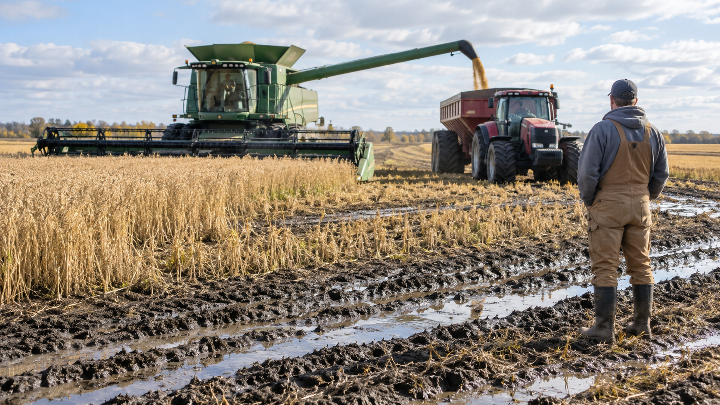
Prairie farmers are working to bring in crops after a wet spring delayed seeding in many areas and renewed rainfall arrived during harvest. Stephen Vandervalk, a fourth-generation southern Alberta wheat grower and vice-president of the Wheat Growers Association, said much of the summer had been very dry before rain returned in recent weeks.
Industry groups say harvesting of several crops is well behind the average pace of recent years, and quality could deteriorate if crops remain in fields too long. Rick White, head of the Canadian Canola Growers Association, said farmers are contending with mud, shorter days and cool temperatures that leave fields slow to dry after significant rain.
Vandervalk said his wheat crop has not been great, though it is not the worst he has seen. He described this year’s crop as by far the most expensive farmers have ever put into the ground, saying an average crop can still leave producers losing money.
Middle East conflict has disrupted global crude oil shipments, while Ukrainian strikes on Russian energy infrastructure have further constrained supply. Natural Resources Canada reported that the national average retail diesel price exceeded $2.75 a litre late last week, more than 80 per cent above roughly $1.50 at the same time last year.
Bruce Burrows, executive director of Grain Growers of Canada, said higher diesel prices have arrived during one of the year’s most fuel-intensive periods and called for a targeted, temporary per-litre federal fuel rebate. Keith Currie, an Ontario farmer who leads the Canadian Federation of Agriculture, said producers need fuel to bring in their crops. Vandervalk said fuel prices hurt, but fertilizer prices have become especially punishing as the Ukraine-Russia and Middle East conflicts disrupt supplies.
Trade uncertainty is also weighing on the sector. J.P. Gervais, executive vice-president of Farm Credit Canada, said the Crown corporation’s monthly survey found farmer concern rose sharply after U.S. President Donald Trump announced universal 10 per cent “Liberation Day” tariffs in spring 2025. Concern later levelled off for more than a year before rising again in the latest poll.
Agricultural commodities and inputs have largely been exempt from the latest cross-border tariff dispute. Canada’s counter-tariffs included U.S.-imported farm machinery parts, though industry groups hope farmers can obtain refunds or waivers through the remission process in certain circumstances.
China’s tariffs on canola products and peas have created another concern. China imposed the duties last year in retaliation for Canada’s levy on Chinese electric vehicles, then added further canola tariffs tied to an anti-dumping investigation. Ottawa announced an agreement with Beijing in March that suspended 100 per cent tariffs on canola meal and peas until year-end and sharply reduced anti-dumping tariffs on canola seed. Greg Cherewyk, president of Pulses Canada, said importers may hesitate to commit to purchases while the tariff outlook remains uncertain, particularly without assurance that a 100 per cent duty will not apply on Jan. 1.
Farmers also depend on reliable rail and port operations to move Prairie crops to coastal waters. Cherewyk said uncertainty can leave products sitting and increase port storage charges. Industry groups cited bottlenecks at the Port of Vancouver, including recent breakdowns on the Second Narrows bridge serving bulk export terminals on Vancouver’s north shore. Burrows said existing infrastructure needs proper maintenance alongside new construction, while agricultural trade associations pointed to repeated rail and port labour stoppages in recent years as another major problem.
Despite the pressures, Gervais said farmers’ full-year 2026 revenues are on track to exceed 2025, helped by sales from last year’s strong crop and high commodity prices. He said the sector remains resilient and that demand for Canadian production remains strong.