 Vancouver
METRO VANCOUVER NEWS
Where Vancouver’s five leading mayoral candidates stand on extending SkyTrain to UBC
Four of Vancouver’s five leading mayoral candidates support extending the Millennium Line from Arbutus to UBC, but differ on funding, timelines and the City’s role. TEAM candidate Colleen Hardwick opposes the project. Provincial leadership and a federal contribution remain key to advancing it.
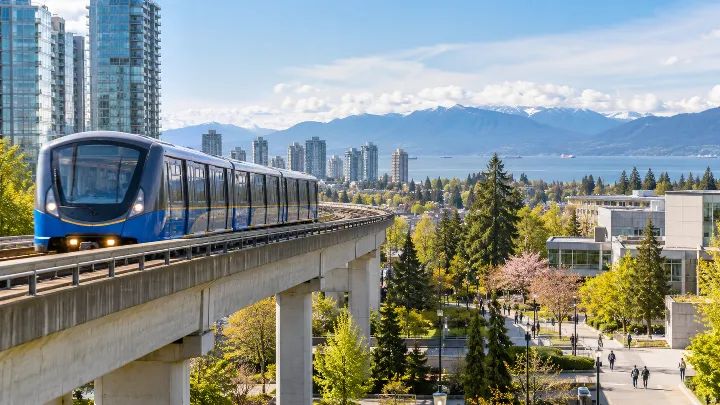
Four of Vancouver’s five leading mayoral candidates support extending SkyTrain to the University of British Columbia (UBC), but they differ on how to move the long-awaited project forward. It ultimately depends on the provincial government taking the lead and the federal government contributing funding. The only opponent is TEAM for a Livable Vancouver candidate and former city councillor Colleen Hardwick.
Incumbent Mayor Ken Sim of ABC Vancouver, Vancouver Liberals candidate Kareem Allam, Green Party of Vancouver candidate and sitting councillor Pete Fry, and Vote Vancouver candidate and sitting councillor Rebecca Bligh have backed the extension through platforms or recent interviews. Their approaches range from seeking senior-government support to pressing the City of Vancouver to secure a binding project timeline. OneCity Vancouver and COPE are not running mayoral candidates, but both are fielding council candidates and explicitly support bringing SkyTrain to UBC.
The planned extension would continue the Millennium Line west from Arbutus Street to UBC’s Point Grey campus. It is separate from the Broadway extension now under construction, which is expected to open in late 2027 and end at the new Arbutus Station. Until the UBC extension is built, passengers will travel from the Millennium Line’s new western terminus at Arbutus on a shortened 99 B-Line route for the rest of the trip to campus. The proposed extension would be about seven kilometres long, with stations at West Broadway and Macdonald Street, West Broadway and Alma Street, the Jericho Lands development, and UBC’s academic core near University Boulevard and East Mall.
**Kareem Allam: Yes**
Since launching his mayoral campaign a year ago, Allam has been by far the most vocal municipal candidate in support of extending SkyTrain to UBC. He has repeatedly pledged to make securing federal and provincial support a top priority as mayor. As the election approaches, he has said he would press the provincial government to commit funding and set a construction schedule. The Vancouver Liberals say they would pursue funding with the next provincial government, TransLink, UBC and First Nations.
Allam links the extension to a broader plan to bring young people back to Vancouver. He argues stronger connections between the university and the city could help create businesses, jobs and long-term career opportunities. He also says linking UBC’s research activity with Vancouver’s employment centres would support economic growth and climate goals. Allam described UBC as the Lower Mainland’s second-largest commuter destination and Western Canada’s largest research centre, and Vancouver as Western Canada’s largest job centre. He said the SkyTrain and a unified Vancouver and UBC would create an innovation corridor for the next generation of jobs.
Allam also proposes bringing the University Endowment Lands (UEL) under the City of Vancouver’s municipal jurisdiction, shifting responsibility for municipal governance from the provincial government to the City. If elected, he says he would submit an amalgamation proposal to the province on his first day in office. The UEL is an unincorporated area with no elected municipal council, separate from both Vancouver and UBC. The B.C. Ministry of Housing and Municipal Affairs provides its municipal services. Allam presents the proposed amalgamation and SkyTrain extension as complementary steps toward closer ties between Vancouver and the university area.
He has also proposed a new agreement with the City of Surrey to jointly advance SkyTrain to UBC and improve rapid transit on King George Boulevard. He argues that working together would strengthen both cities’ efforts to secure provincial and federal funding.
**Ken Sim: Yes**
Former Vancouver mayor Kennedy Stewart recently accused Sim and ABC Vancouver on the Coastal Front podcast of squandering progress toward the UBC extension. Stewart alleged that Sim failed to carry forward partnerships assembled before the 2022 civic election. He said Sim had “basically had a gift sitting on his desk” and had “just botched it.” Stewart described an arrangement with then-Surrey mayor Doug McCallum to support each other’s SkyTrain priorities through TransLink’s Mayors’ Council: Vancouver would help advance the Expo Line’s Surrey–Langley extension first, and Surrey would then back a further Millennium Line extension to UBC.
Stewart said the UBC project had support from First Nations willing to invest, a potential contribution of hundreds of millions of dollars from UBC’s administration, and Vancouver’s municipal government. He alleged the change in Vancouver’s leadership derailed that cooperation. “Election hits, deal dies,” he said. Allam subsequently endorsed Stewart’s account, saying he had received project briefings during the transition between administrations. Allam managed Sim’s ABC campaign in the 2022 civic election and briefly served as chief of staff in Sim’s mayor’s office from November 2022 to February 2023, taking the role just after Sim’s inauguration. The two later fell out and are involved in legal disputes over other allegations. Allam said in a statement that he could attest Stewart’s account was true because he received the briefings during the transition. He also argued that Sim failed to capitalize on regional support and senior-government commitments to fund planning.
In an interview with Daily Hive Urbanized earlier this week, Sim and ABC Vancouver councillor and candidate Sarah Kirby-Yung rejected Stewart and Allam’s criticisms and allegations. They said they fully support the extension and have continued pressing provincial and federal governments to advance it. Sim said UBC SkyTrain was a major topic at a meeting with Prime Minister Mark Carney in Ottawa about three months ago. He described the extension as nationally important infrastructure linking UBC with the region and connecting employment, research and health-care destinations along the Broadway corridor. Sim said a meeting with Carney this past summer also covered expansion of local port facilities and Vancouver International Airport. He told Daily Hive Urbanized the extension was a “no-brainer,” saying they had been discussing it for a long time and fully supported it.
In October 2025, Sim successfully amended a Vancouver City Council motion asking the federal government to designate UBC SkyTrain a “Project of National Interest” under the Prime Minister’s new federal Major Projects Office. The motion, originally introduced by OneCity councillor and candidate Lucy Maloney, calls on the province to expedite the business case and detailed technical planning, and to set clear timelines for planning and construction. It also urges the provincial and federal governments to commit funding in partnership with TransLink, UBC and local First Nations.
Kirby-Yung said the business case had been funded and was under review, and that its technical findings were needed to determine the route and final costs. She said City officials had repeatedly sought updates from provincial ministers but were still waiting for the business case work to be released, a critical step toward advancing the project. She described the response from the provincial and federal governments as “a pinball back and forth,” with both saying they were waiting for the business case. She rejected Stewart’s allegations, saying the City remained committed and his comments were “just ridiculous.” Sim added that he would have preferred the UBC extension to proceed as one larger project alongside the Broadway extension now under construction. He said his administration continues to lobby the provincial and federal governments.
The project’s planning and funding history complicates Stewart’s suggestion that Sim inherited an extension ready to proceed. By spring 2022, only very preliminary studies had examined possible routes, station locations and costs, and the Mayors’ Council had endorsed an initial concept. There were no accurate construction cost estimates because the technical details had not been settled. The full business case needed to support construction funding from the federal and provincial governments and final approval decisions was still outstanding. Political support had advanced the proposal, but substantial technical and financial questions remained.
The difference between planning and construction funding was clear in a July 2021 federal announcement. Then-prime minister Justin Trudeau committed up to $1.3 billion toward building the Surrey–Langley SkyTrain extension. For UBC SkyTrain, the federal government’s initial commitment in the same announcement covered up to 40 per cent of eligible technical design, planning and business-case costs. The province subsequently received a $14-million federal contribution toward the approximately $40-million total cost of that work.
City of Vancouver records from the final weeks of Stewart’s administration in 2022 show the City was still seeking provincial commitments. In a September 2022 briefing package for the Union of B.C. Municipalities convention, it asked then-premier John Horgan to honour the province’s previously announced commitment to fund 40 per cent of the total planning and business-case cost, and to extend that commitment to construction costs. The request indicates that the City was still seeking a provincial construction-funding commitment shortly before the municipal election.
For government capital projects, a business case sets out what would be built, estimates construction and operating costs, assesses benefits and risks, and informs decisions about how to pay. TransLink identifies completing that work as necessary to secure project funding and approval. Technical planning and business-case work was completed before senior-government funding was secured for projects such as the Surrey–Langley and Broadway extensions. Such work was also done for the proposed Burnaby Mountain gondola to Simon Fraser University’s main campus. Support from neighbouring mayors, UBC and First Nations helps build the political case but does not resolve the engineering, cost and funding questions involved in delivering a SkyTrain extension.
The provincial government took over project leadership from TransLink in September 2022, including responsibility for detailed technical analysis, the business case and a funding strategy. In March 2023, it began seeking consultants to assist the B.C. Ministry of Transportation and Transit with the technical design and planning needed for the business case. The selected firms were engineering firm Stantec and architecture firm Perkins&Will. Their work was to establish baseline designs for architectural, structural, geotechnical and seismic considerations, municipal roadworks, utilities and SkyTrain systems. They were also to determine station locations, elevated and underground guideway areas, tunnel entrances, cut-and-cover and tunnel-boring sections, property impacts, construction staging areas and traffic management.
The province also asked the consultants to consider transit-oriented development and affordable housing when establishing station locations and designs. That included examining whether the Macdonald Street and Alma Street stations could be integrated into new developments, as well as other transit-oriented development opportunities on the Jericho Lands and at UBC. Geotechnical investigations along the route began in May 2024 and ended in November 2024. Crews extracted soil samples for analysis at 100-metre intervals along the entire route from Arbutus Street to UBC. By fall 2025, the province said it had completed a substantial portion of the business-case work and was examining the financial framework.
The province continued allocating money to plan the extension in 2026, but no potential construction timeline was available. During an exchange in the B.C. legislature in May 2026, Conservative MLA Harman Bhangu asked Transportation and Transit Minister Mike Farnworth about provincial funding and when the project might move from planning toward construction. Farnworth said the province had matched the federal government’s $14 million for planning and added $5 million in that year’s budget for the work to continue.
Farnworth said the extension still needed to be included in a future TransLink investment plan. He reiterated that the transit authority expected to advance it in the second half of its 10-year planning period, sometime in the first half of the 2030s, making it a medium-term priority. The province would continue working with TransLink and the federal government to secure the major construction funding required. Farnworth gave no construction start or opening date, leaving both milestones unresolved despite the additional design and planning funds. Billions of dollars in construction funding remained unsettled before Sim took office, and provincial planning continued well after the 2022 election, though Stewart attributes lost momentum to the change in City leadership four years ago.
The UBC extension was a key platform priority for Premier David Eby and the BC NDP during the October 2024 provincial election. Eby’s January 2025 mandate letter to the B.C. Ministry of Transportation and Transit reaffirmed the project as a priority for the newly elected provincial government. But with one week until the Oct. 24, 2026, provincial election, Eby and the BC NDP had not included UBC SkyTrain in their current campaign platform. They had pledged $250 million toward the $700-million cost of TransLink’s proposed King George Boulevard bus rapid transit line in Surrey and legislation to give TransLink a major new revenue source. In its 2026 budget announcement earlier this year, the BC NDP-led provincial government said it would slow capital spending to help reduce forecast large annual deficits and rising provincial debt, which it said were partly driven by significant capital spending.
**Pete Fry: Yes**
Green Party of Vancouver mayoral candidate Pete Fry explicitly supports the UBC extension and emphasizes setting a firm schedule. The party’s public transit platform says it wants to “set a binding timeline for rapid transit to UBC” and refers to the project as the “UBC subway extension.” The platform does not give an opening year or explain how the timeline would bind the provincial government and TransLink.
**Rebecca Bligh: Yes**
Vote Vancouver candidate Rebecca Bligh also supports extending SkyTrain to UBC. Her party’s transportation platform says taking the Millennium Line west of Arbutus Street would shorten trips and ease pressure on busy roads. It states, “The Broadway Subway shouldn’t stop at Arbutus,” and says Vote Vancouver will extend the line to UBC for people who live, work and study in the area.
**Colleen Hardwick: No**
Hardwick’s TEAM for a Livable Vancouver opposes the project. She proposes reconsidering the City’s official support for extending SkyTrain to UBC and the transit-oriented development plans associated with it. The party platform calls for public consultation and suggests the City use its influence at the Mayors’ Council to ensure the business case fully examines the extension’s viability and alternatives.
The position is part of TEAM’s broader proposal to rescind the City’s Broadway Plan, Jericho Lands Official Development Plan (ODP) and citywide Vancouver ODP. TEAM wants to rethink the planned high-density, mixed-use Jericho Lands development, which includes dozens of high-rise towers, in favour of more low- and mid-rise buildings and a greater resident role in shaping neighbourhood growth. The current assumption is that the Jericho Lands would be anchored by an on-site SkyTrain station.
Hardwick’s party favours spreading transportation investment across Vancouver’s major roads through battery-electric bus options it considers more affordable. Its proposals include working with TransLink to increase bus frequency, expand trolley-bus and battery-electric bus service, restore neighbourhood and express bus routes that were cut, and introduce smaller community buses in underserved areas. Its stated goal is to put every resident within a five-minute walk of a bus stop. TEAM also proposes restoring streetcars on selected major streets where passenger demand would justify them, drawing on the City’s 2019 streetcar feasibility study, which focused on local-serving routes in False Creek South and the Downtown Vancouver peninsula.
During the 2018 and 2022 civic election campaigns and her 2018–2022 council term, Hardwick repeatedly disputed the need for SkyTrain extensions to Arbutus and UBC, advocating instead for street-level light rail transit (LRT). TransLink’s technical assessments of rapid transit to UBC, released during her term, identified SkyTrain as the technology capable of meeting the corridor’s long-term ridership demand and potential. The assessments deemed street-level LRT a medium-term solution at best.