 Vancouver
METRO VANCOUVER NEWS
Chemical tank explosion in Ohio triggers evacuations and fears of another blast
A tank began leaking Tuesday night and exploded in Toledo, forcing residents to evacuate or shelter indoors. Officials said testing was continuing to assess airborne chemical levels and potential health risks.
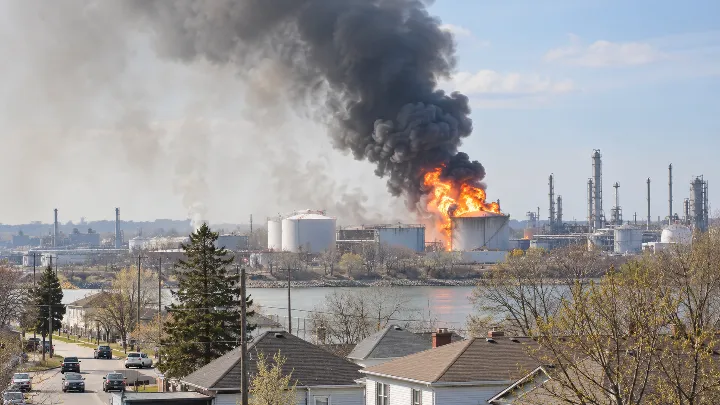
A chemical tank explosion in Toledo, Ohio, forced hundreds of residents from their homes Wednesday, while others were told to stay indoors amid fears of a toxic release and another blast. Videos showed a plume still billowing from the tank early Wednesday afternoon, more than 14 hours after it began leaking Tuesday night. City officials said some residents reported eye and throat irritation. A sheriff’s deputy who responded to the explosion drove himself to hospital because he felt unwell.
MC Tank Transport said the tank contained glycidyl methacrylate, an industrial chemical used to improve the performance of some plastics, paints and coatings. The Ohio Environmental Protection Agency said the leak resulted from an error during the transfer of the material, without giving further details. The tank was in a largely industrial area. Mayor Wade Kapszukiewicz said at a news conference Wednesday morning that nearly 1,000 residents had been told to evacuate overnight within a one-mile (1.6-kilometre) radius of the explosion.
A shelter-in-place order covered a three-mile (4.8-kilometre) radius, including neighbourhoods along Lake Erie and an area just across the state line in Michigan. Schools across Toledo were closed Wednesday. Health officials said reported symptoms so far were primarily eye and throat irritation. Testing was continuing to determine the chemical’s concentration in the air and whether it posed additional health risks.
Kristine Kowalinski, who lives just outside the affected area, said she was staying inside because she is sensitive even to smoke from outdoor wood burning. She said she was worried about what might be in the air and on the ground. “My main concern is how did that affect everything overnight when it was raining down on cars, houses, my garden,” she said.
Kapszukiewicz said the chemical is liquid inside the tank but becomes a gas when released. He said there was still concern that the tank was emitting the chemical and that it had the potential to be explosive within 12 hours of the incident. The tank can hold 5,500 gallons of the chemical in liquid form, he said. Officials do not know what caused the explosion.
The city fire department said people who come into contact with glycidyl methacrylate may feel a burning sensation in their eyes, nose, mouth and skin. Overexposure can cause headache, dizziness, tiredness, nausea and vomiting. Karim Baroudi, director of the Toledo-Lucas County Health Department, said the chemical is highly toxic on contact or if ingested. Officials were working to determine the level of toxicity in the air people were breathing so they could provide better guidance.
Baroudi advised residents to close their windows and said those experiencing eye irritation or heavy breathing should take a shower for now. The fire department said people with symptoms should contact a medical professional. Kapszukiewicz said emergency and hazardous materials crews were not approaching the tank because of the risk of another explosion.
Arkansas-based MC Tank Transport said it was working with the fire department and other emergency authorities. Kapszukiewicz said company representatives were on their way to Toledo. The company said its overriding concern was the safety of area residents, emergency responders and employees.