 Vancouver
METRO VANCOUVER NEWS
Pete Fry’s Green Party platform proposes Broadway bike lanes and municipal housing bonds
The 71-page Vancouver platform proposes changes spanning housing, transportation, public safety and city services ahead of the Oct. 17 municipal election; many measures would require cooperation from senior governments or TransLink.
The Green Party of Vancouver released its 71-page election platform, setting out proposals for Vancouver City Council, the Park Board and School Board ahead of the Oct. 17 civic election. Pete Fry, a councillor first elected in 2018, is running for mayor against incumbent Ken Sim and his ABC majority on council. The party says it would reverse some ABC policies, expand public services, strengthen environmental requirements and change how City Hall measures affordability and its own performance. The Greens are also running four council candidates: 2025 byelection candidate Annette Reilly, Bridget Burns, former Park Board commissioner Camil Dumont and Stephanie Smith. They have three Park Board candidates, including incumbent Tom Digby, and two School Board candidates. Under an agreement with COPE and OneCity Vancouver, the Greens limited their candidate slate to reduce competition among progressive candidates. The same agreement led COPE’s Stephanie Allen and OneCity’s William Azaroff to leave the mayoral race earlier this month, in an effort to improve Fry’s chances.
Housing is a central plank. The party would measure affordability against local household incomes, setting housing affordability targets at 30 per cent of median household income and using that benchmark in reporting instead of measures tied to market rents. A proposed Vancouver Affordability Index would compare household expenses with local incomes to inform decisions on housing, transportation, taxation and development. The platform says city policies should be judged by whether they improve affordability for residents, rather than by outdated or market-based benchmarks. The Greens would also create a municipal housing bond program through which individual and institutional investors would finance affordable, City-owned housing in return for a financial return; the homes would remain publicly owned. They would prioritize affordable housing, co-operatives and community land trusts on City land, and establish a fund to let the City move quickly to acquire lower-cost secured purpose-built rental buildings at risk of redevelopment or speculation. The proposed preservation program would include partnerships and be similar to the B.C. Rental Protection Fund. The provincial fund has set aside $500 million since 2023 to finance an arms-length non-profit entity’s purchases of older secured purpose-built rental buildings considered at risk of sale, redevelopment or sharp rent increases.
The party would restore a dedicated Renters’ Office to help tenants navigate City processes, monitor rental-home losses and displacement, and track landlords and problem properties. Vancouver’s previous Renter’s Office, spearheaded by Fry during his first term on council, was closed by the ABC-majority council in January 2023 after very low usage. It handled roughly 370 inquiries a year, or about one call a day. ABC argued that the office duplicated renter assistance provided by the provincial government and non-profit organizations. The Greens would strengthen relocation protections for tenants affected by redevelopment, including tenants in unsecured rental housing such as condominiums, basement suites, laneway houses and detached homes rented by individual owners. They would offer more moving and compensation assistance, review compliance with the City’s Empty Homes Tax and work with the province to address gaps that allow some condominium buildings to remain empty, ahead of a gradual tax-rate increase. Large residential developments would have to include affordable housing or contribute land, homes or money toward affordable housing elsewhere. A new City housing role would develop partnerships and policies for non-market and supportive housing; qualifying affordable projects would receive faster approvals and reductions in City fees and levies.
The platform supports co-operative, social and supportive housing across the city, alongside more conventional choices: four- to six-storey wood-frame apartments, townhouses, rowhouses and infill homes, with greater use of modular and prefabricated construction. The Greens would reverse the policy allowing homes as small as 250 square feet. They also propose pre-approved building designs and exploring a new generation of Vancouver Special-style kit homes to reduce permitting and construction time and cost. Existing co-operatives on City land, including those on the False Creek South waterfront, would receive faster attention to planning and lease renewals, with affordability and resident mix as priorities.
For businesses, the Greens propose a dedicated service to guide owners through permits and licences, faster approvals for changing existing storefront uses, and an expanded role for the City’s Business and Economy Office. They would seek provincial changes to ease disproportionate property-tax increases on small businesses and strengthen protections for commercial tenants. Major redevelopments would have to replace affordable commercial space otherwise lost. The platform supports converting office space to residential use, attracting educational institutions downtown and allowing a wider mix of uses in commercial buildings. Large data centres with substantial electricity, water and local-infrastructure demands would face new zoning rules and conditions requiring greater community benefits. The party also backs protecting industrial land and expanding opportunities in film, gaming, clean technology and other employment sectors.
For development more broadly, the party would apply standardized rezoning rules to individual projects while adjusting building heights, setbacks and layouts to neighbourhood conditions. It would seek changes to the provincial government’s legislated housing targets for Vancouver, arguing that slower construction and lower immigration levels have made the targets set in 2023 unachievable. Other proposals include limiting the time between a rezoning taking effect and construction starting, restoring development agreements intended to support local employment and purchasing, and creating more opportunities for public input on major zoning changes within provincial rules.
The affordability agenda also covers child care, recreation and food. Providers would receive simpler approvals and lower permit costs, and suitable City-owned spaces could be offered at below-market rents. The Greens would work to add child care to community centres and support services outside conventional daytime hours. They propose expanding recreation assistance and low-cost programs, along with lending libraries for tools, sports equipment and other items residents might otherwise have to buy. Food measures include more community gardens and neighbourhood food hubs combining services such as meal programs, kitchens and distribution. The City would support surplus-food recovery, provide more certainty for recurring farmers’ markets and fill school-meal funding gaps when provincial and federal contributions fall short.
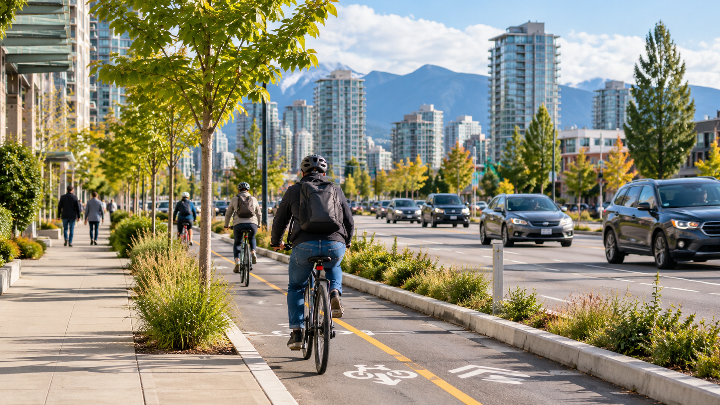
On transportation, the Greens propose converting at least 11 per cent of Vancouver roads from vehicle use to public, green and active-transportation spaces. Examples include treed areas, small parks, dog parks, pedestrian routes, bike lanes and food-growing spaces. The platform does not identify the streets to be changed, but commits specifically to bike lanes on Broadway. It says the new Broadway subway will reduce road traffic and create an opportunity to add active-transportation lanes for shoppers, couriers and commuters while construction continues. The platform argues that without active transportation, Broadway would fall short of its potential as a great street.
In 2023, the ABC-led council rejected bike lanes in the permanent street design for seven blocks of Broadway that were excavated to build five stations for the SkyTrain Millennium Line Broadway extension. Two alternative ways of adding bike lanes would require the municipal government to renegotiate with the provincial government and the subway contractor because tunnel vents and other critical station infrastructure dictate the street design. One option would remove expanded sidewalk space for pedestrians, patios and trees while retaining four vehicle lanes, two in each direction. The other would keep the widened sidewalks but reduce Broadway to two vehicle lanes, one in each direction. The sidewalk-widening plan is intended to create a “Great Street” for pedestrians. Broadway is part of the regional Major Road Network, so narrowing it requires TransLink’s permission. TransLink previously endorsed narrowing it only to four vehicle lanes, down from six. City staff warned that reducing it to one lane in each direction would cause extreme congestion. Other sections of the Central Broadway area generally have up to six vehicle lanes. The platform does not say whether the party would seek to remove lanes outside the station-construction blocks for a Broadway bike lane.
Broadway is one of Vancouver’s few major east-west arterial roads and an important regional route for freight trucks, public transit buses and emergency vehicles travelling to the Vancouver General Hospital campus. Subway construction has brought a notable increase in congestion on 12th Avenue to the south and the 2nd/4th/6th avenue corridor to the north. Redevelopment catalyzed by the City’s Broadway Plan is projected to add 50,000 residents and 40,000 jobs over coming decades, with Broadway one of its key transportation spines. The Greens would address other perceived gaps in the cycling network, especially in East Vancouver and South Vancouver. Seasonal and permanent pedestrian areas would receive more dependable funding and infrastructure, including retractable barriers to manage vehicle access, potentially benefiting efforts such as the return of the Granville Street Pedestrian Zone.
For transit, the party would work with TransLink on dedicated bus lanes, intersection improvements and other changes to make buses faster and more reliable. It would seek expanded late-night service and lower fares for people with lower incomes. The Greens would pursue a “binding timeline” with TransLink and the provincial and federal governments to extend the Millennium Line to UBC, but the platform gives no dates. Road-safety proposals include continuing and expanding 30 km/h speed limits on residential streets and select arterial roads, extending school-zone restrictions beyond their current days and hours, creating more car-free areas beside schools at arrival and dismissal, and making crossings safer for pedestrians. Parking would be reviewed against neighbourhood demand, with lower requirements near frequent transit and some spaces repurposed for plazas, bike lanes and greenery. The party would explore requiring high-volume online-shopping delivery and logistics operations to contribute fairly to the public infrastructure they use.
The public-safety centrepiece is the Community Response Outreach Workers (CROW) team, announced the previous week. The proposed service would operate 24/7, sending workers who are neither police officers nor medical responders to non-emergency situations involving homelessness, addiction or mental-health issues. Residents and businesses could call a dedicated number; the aim is to free police and paramedics to handle emergencies. In its announcement, the party said workers would respond in pairs without uniforms, sirens or emergency lights. A new Office of Community Safety would coordinate work across police, fire, licensing, property-use enforcement and planning, rather than leaving departments to address neighbourhood problems separately.
The platform says people need somewhere to go, not just somewhere to leave. The Greens would expand daytime spaces where people experiencing homelessness could rest, access services, store belongings and receive housing assistance. They also propose small shelter villages with private, lockable cabins, washrooms, storage and on-site support as a step toward permanent housing. The party would reverse the City’s restriction on enabling a net gain of supportive housing and use occupancy requirements to help ensure those buildings have adequate staffing and support services. It would also set conditions for health and shelter facilities covering cleanliness, public safety, service delivery and effects on neighbours, with the stated goal of reducing public drug use and overdose risks.
For the environment, the Greens would adopt a “3-30-300” approach: every household should have a view of three trees, every neighbourhood should have 30 per cent tree-canopy coverage, and every resident should live within 300 metres of green space. The party proposes stronger protection for mature trees, incentives for developers to retain significant trees and more replacement planting when trees are removed. A new municipal arborist office would independently assess tree-related decisions, and occupancy approvals would be tied to checks on the health of protected trees affected by construction. Other proposals include green roofs on larger new and existing buildings, buying additional parkland with development levies, and restoring the City’s standalone Sustainability and Climate Office.
Arts and events would receive a new municipal Festival Fund for dependable annual support. The Greens would restore and expand City arts staffing and grants, protect affordable creative spaces, support non-profit ownership of studios and cultural venues, and simplify approvals for eligible venues. The Park Board section supports preserving the independently elected board and reducing its reliance on user fees. It calls for $6 million to be returned to the board’s budget and for the City-funded share to reach 50 per cent. Priorities include renewing Hastings, Kensington and Renfrew community centres while continuing work toward renewal of the aging community and recreation facilities at the Britannia civic hub. The party also supports renewing Vancouver Aquatic Centre, Kitsilano Outdoor Pool, Kerrisdale Pool and Britannia Pool, and building a new 50-metre pool at either Hastings or Kensington.
For future civic elections, the Greens would pursue ranked ballots for mayor, allowing voters to list candidates in order of preference. They also support a voluntary lobbyist registry, independent ethics oversight, more disclosure of decisions made behind closed doors once confidentiality is no longer needed, and greater public access to City Council proceedings. Residents would have a direct say over part of neighbourhood spending through participatory budgeting. Public reporting tools would track services and major projects, while more detailed budgets would make spending easier to follow. The platform provides no overall cost estimate, year-by-year financial plan or estimate of the resulting property-tax impact. Many initiatives would also require cooperation or funding from TransLink or senior governments.