 Vancouver
METRO VANCOUVER NEWS
Ken Sim defends public safety plebiscite and promises 50-metre pool if re-elected
Vancouver Mayor Ken Sim is seeking re-election with public safety at the centre of his campaign. He defended two proposed plebiscite questions and pledged to deliver a 50-metre pool at the Vancouver Aquatic Centre if ABC wins another term.
Ken Sim is seeking re-election as Vancouver’s mayor, with public safety again at the centre of his campaign. In August, before the municipal campaign period began, Sim and his ABC party voted to put a public safety plebiscite on the Oct. 17 ballot. Voters will answer two questions: whether Vancouver should strengthen laws against open-air hard drug use in public spaces, and whether the city should formally ask the province to convert part of the former St. Paul’s Hospital, or a similar site, into a secure medical facility with acute voluntary care and more than 100 involuntary care beds. ABC Vancouver’s platform also has two pillars, “restoring Vancouver” and “raising Vancouver.” Its promises include a second consecutive annual property tax freeze, removing parking fees at beaches and community centres, new public swimming pools, and 4,200 rental homes on city-owned land. Daily Hive Urbanized interviewed Sim and ABC Coun. Sarah Kirby-Yung, who is also seeking re-election, about the challenges of their first term, Vancouver’s issues and how they would govern for the next four years if re-elected.
**The past four years**
Sim and ABC Vancouver won a landslide victory in 2022, emphasizing crime, public safety and public disorder. Their platform had 93 promises, ranging from climate action and public safety to child care. Sim acknowledged they did not accomplish everything they initially set out to do. He said they entered office with high expectations and a mandate for change, but he underestimated the challenges and the scale of the problems.
Sim said the city’s finances looked “horrendous” when they reviewed them. Municipal reserves stood at $33 million when they took office, he said, against a city budget of about $3 billion covering operating and capital costs, with “no safety net whatsoever.” He said he was not blaming the previous administration, which had to deal with the COVID-19 pandemic. His administration had to rebuild reserves, fully fund the police and fire departments, and increase investment in sidewalks after years of flat funding and worsening pavement conditions. Sim said it took a couple of years to fix the financial foundation. He also said he had been wrong to think he could enter City Hall with a business mindset.
He said his team had to learn how politics works at municipal, provincial and federal levels. It took about two years to understand the incentives involved in working with individuals, the bureaucracy, other parties, Victoria and Ottawa, he said. Sim said they had assumed everyone was working in the public interest, but that had not always been their experience; politicians are rewarded based on how they think people will vote, he said.
**Public safety plebiscite**
The plebiscite, promoted by Sim and ABC Vancouver, has become a major issue in the municipal campaign. In August, they introduced a policy paper proposing two advisory questions, arguing the city should seek a direct public mandate on issues that span municipal and provincial responsibilities. ABC’s council majority passed the plebiscite at a contentious special meeting held during the council’s scheduled summer break. Voters can mark yes or no on each question.
Sim said he had heard from Vancouver residents across the political spectrum who were glad to have an opportunity to express their views. He said most people feel unsafe in the city. Critics and political opponents say open hard drug use is already illegal, the former St. Paul’s site is unsuitable for a mental health facility, and council could act without a plebiscite. Sim said his side hears those arguments often and wants to correct the record.
He described current enforcement of open hard drug use as effectively nonexistent. If officers see someone using hard drugs in a public space, they can arrest and charge the person, seize the drugs, prepare a report and submit it to Crown counsel. Sim said the process can take one or two officers anywhere from half an hour to an entire shift, making it cumbersome to administer. Under his proposed approach, the city would pass a bylaw allowing officers to issue a bylaw infraction ticket and seize the drugs, but without a fine. Sim said that would avoid arrests because these should not be arrestable offences. He added that repeated encounters with an individual would trigger a health-care response and an assessment of whether they pose a serious risk to themselves or others, or face serious deterioration or death.
If the criteria are met, Sim said, the person could be detained under the Mental Health Act. The act allows a physician or nurse practitioner to assess someone experiencing severe mental health issues who poses a risk to themselves or others, and admit them involuntarily to care. Sim maintained that the former St. Paul’s site is viable despite objections that it is privately owned, not seismically safe and faces general opposition as a downtown location. He said involuntary care is widely used in the province, but people are often released soon afterward without adequate care. About 70 beds at the former hospital are already used for involuntary care, he said. Sim argued that means the site is close to a turnkey option, while stressing the province can decide for itself and the city is making a recommendation.
Sim said the city had already made these requests to the province and sought a city-wide mandate through the plebiscite. He cited a random violent attack in September 2024 in which a man’s hand was severed and another person was killed, calling it “the straw that broke the camel’s back.” The individual, Brendan Colin McBride, had more than 60 documented interactions with police across Metro Vancouver. After the attack and killing, Sim said, they asked the province for involuntary care beds. The province agreed to provide 400, he said, and had delivered about 200 to date, but none in Vancouver for Vancouver residents. Sim said a yes vote by a majority would send a strong message to the province. He rejected the suggestion that his administration had done nothing until now, saying it had been working on the issue since taking office.
**Sim’s housing plan**
Sim said the city approved almost 60,000 homes of all types between November 2022 and July 2026, including supportive, social, non-market and market housing, missing-middle homes, townhouses and condos. He credited changes to city systems that made permitting faster. ABC Vancouver says it cut about 1,850 pages of regulatory red tape, relaxed the view-cone policy and reviewed the city’s shadow policy. Sim said the city passed its Official Development Plan (OCP), reducing the need for public hearings on new projects that already comply with it.
Sim said tough economic conditions mean approved projects are not necessarily reaching construction. Coun. Sarah Kirby-Yung pointed to the party’s development viability report, intended to help projects proceed. It includes deferring development cost charges — fees the city collects to fund infrastructure — so developers can pay later when cash is coming in. Kirby-Yung said the measures had helped unstick some projects, which were moving ahead to construction. She added that the city had advanced multiplexes to fill the missing-middle gap and was working on pre-approved designs. She called single egress stairs, which can free up more multiplex space for homes, one of the biggest changes for making missing-middle housing achievable in neighbourhoods. People cannot live in an approval, she said, and the city is willing to consider fee reductions or different payment timing to get projects built.
ABC is also promising 4,400 rental units on city-owned land. Earlier this year, council approved several major rental projects, but non-ABC councillors opposed them, concerned that city land would be used only for market rental housing rather than affordable housing.
**Jobs and the economy**
Sim said jobs and the economy are the other side of affordability: low-cost housing alone does not help if people cannot find work. He said the city is making it easier for businesses to establish and succeed, and cited council support for Web Summit, the FIFA World Cup, an extension of the Granville Pedestrian Zone and a fireworks show on the B.C. Day long weekend. ABC promised to bring back the pedestrian zone next summer if elected. Sim said the city sometimes steps beyond its usual lane to support such events.
He cited a zero per cent property tax increase and efforts to speed up permitting, but said public safety is the most important contribution the city can make. If people do not feel safe visiting a shop, it will have neither workers nor customers, he said. Sim said Vancouver received no direct revenue from Web Summit, but the event runs for at least three years. In its coming third year, he said, as many as 40,000 delegates could visit Vancouver, generating about $500 million in economic activity for the city. Vancouver committed $5 million to hosting the FIFA World Cup. Sim said the city would receive no revenue from that either, but called it a major branding opportunity.
**Park Board promises**
ABC’s platform promises to remove parking fees at Spanish Banks and Jericho beaches and at community centres. Sim said fees at public amenities can affect people struggling to afford food; even a $2, $3 or $5 charge can influence decisions. He noted that the fees were approved during ABC’s tenure, but said the decision fell under the Park Board’s authority. ABC needs a majority to make the changes, he said.
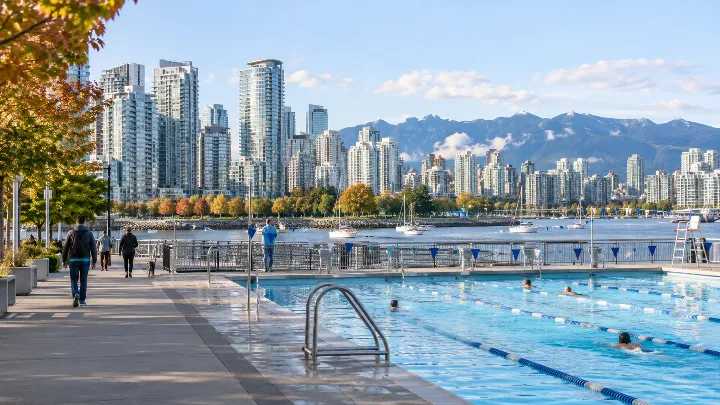
The party also promises a 50-metre pool at the Vancouver Aquatic Centre, which is currently slated for redevelopment with a 25-metre pool. Park Board staff concluded that a 50-metre pool could not fit within the existing building footprint alongside the other planned aquatic amenities while meeting required standards. They said it would require a redesign and a larger footprint, significantly increasing construction costs.
The change from a 50-metre pool to a 25-metre pool has been contentious. A community group and pool users challenged the replacement plan in the Supreme Court of British Columbia because replacing the pool had been a plebiscite question in the previous municipal election. The court dismissed the challenge. On Oct. 13, the B.C. Court of Appeal temporarily halted any further demolition of the current centre until Nov. 3, 2026.
Despite the obstacles, Sim promised to make a 50-metre pool happen. He said Vancouver residents clearly want it and that he is personally committed to delivering it within budget. He said companies based in Vancouver or B.C. would be enthusiastic about building it, and dismissed concerns about needing a few extra feet as solvable. Asked by Daily Hive Urbanized whether it was legally too late, Sim replied, “No. Look, do we have shovels in the ground yet?”
**SkyTrain to UBC**
Shortly before the interview, a video surfaced of former mayor Kennedy Stewart saying a SkyTrain line to UBC was “so close” and Sim had “basically had a gift sitting on his desk” to get it done. Kirby-Yung called the comments ridiculous. She said funding for the business case had been approved and it was under review; everyone must wait for it to determine the alignment and final costs. She said the city was waiting like everyone else, while the provincial and federal governments were going back and forth, each waiting for the business case or the other government’s funding. Vancouver is committed, she said, and she again called Stewart’s comments ridiculous.
Reporting contributions from Kenneth Chan.