 Vancouver
METRO VANCOUVER NEWS
Richmond Votes: Seven candidates vie to become Richmond’s next mayor
Seven candidates are running to replace longtime Richmond Mayor Malcolm Brodie, who is stepping down after 25 years. Five took part in a forum organized by the Richmond Poverty Reduction Coalition, discussing housing, homelessness, safety and other social policy issues.
Richmond will have a new mayor after the Oct. 17 municipal election, with seven candidates on the ballot as longtime Mayor Malcolm Brodie steps down after 25 years. Two candidates are current councillors: former Olympian Alexa Loo, who has served three terms, and former Vancouver Police Insp. Kash Heed, who has served one. Rob Howard also served on council in the 2000s, after winning a 2001 byelection, and remained until 2009, when he ran provincially.
All three have ties to the now-defunct BC Liberals, whose MLAs have largely moved to today’s Conservative Party of B.C. Heed and Howard served one term in the same provincial government from 2009 to 2013, first under Gordon Campbell and then Christy Clark. Heed represented Vancouver-Fraserview and served as minister of public safety and solicitor general; Howard represented Richmond Centre. Loo ran for the BC Liberals in the 2020 provincial election but narrowly lost to NDP candidate Henry Yao. Dickens Cheung ran as an independent in Richmond Centre in the 2024 provincial election.
Cheung is now running for mayor with five council candidates on his We Are Richmond slate. Loo’s Richmond Strong slate has three council candidates, while Howard’s Richmond Forward slate has five. Heed is running independently, without a slate. Mei Kang, running under the Action Richmond banner, has owned and operated Happy May Child Care Centre at Alderbridge Way and Garden City Road for more than 20 years. Candidate Goldentiger King’s slogan is “Make Richmond rich again.” Local fitness trainer Dennet “The Cat Guy” Lee said Richmond should operate like a business, with every resident a valued customer, appreciated employee and shareholder.
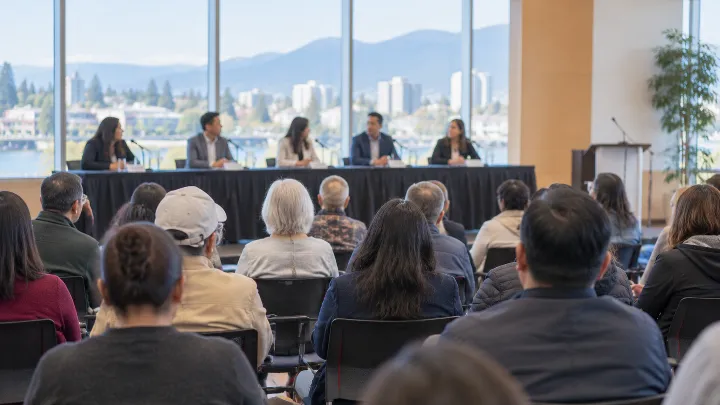
At a mayoral debate at Thompson Community Centre earlier this month, five candidates answered questions compiled by the Richmond Poverty Reduction Coalition. King and Lee did not participate. After presenting their visions for Richmond, the candidates answered questions on social justice topics, including housing, food security, climate change, community spaces, homelessness and safety, as well as child care. The questions were tailored to each candidate.
Cheung said We Are Richmond reflects his vision of a city where no one is left behind, every voice is heard and every opinion matters. He said only a quarter of residents voted in the last election because many did not believe their voices mattered, which he attributed to past leadership. Howard called Richmond a “great city,” but said greatness requires vision, leadership and teamwork. Heed said his vision includes growing the economy so Richmond works for families, caring for seniors and providing affordable, accountable government. “None of this is going to happen if we cannot build the economy in Richmond,” he said.
Kang said she wants to grow Richmond’s economy so more people can stay and raise families there. With the airport and industrial lands in the city, she wants to see well-paying jobs created for residents. Loo called Richmond a “great place” and said she wants it to remain a good place to grow up and raise a family. She said that means encouraging good jobs and transportation so residents can choose to stay and raise their families there.
On housing, Cheung said provincial Bills 44 and 47, introduced almost three years ago to increase density in single-family neighbourhoods, do not “respect” Richmond neighbourhoods. He wants housing approvals fast-tracked to reduce wait times for developers and non-profits seeking to build homes.
Heed defended his vote against renewing the land lease for Aster Place, a low-barrier supportive housing complex near Costco. He said the discussion about supportive housing has been “hijacked” for political gain. The province, he said, needs to provide a continuum of care for people with drug addictions and mental health issues. Other vulnerable people, including those with physical disabilities or cognitive challenges, should have supportive housing, he said. “The word ‘supportive’ has a very negative connotation now,” Heed said. “We’ve got to change that — we’ve got to rewrite what we do here in Richmond.”
Asked about seniors’ housing, Howard said there is a shortage of all types of housing for older adults, leaving some in hospitals, sent out of the community or at home with family members providing care. He said the city needs a full range of options, from independent and assisted living to long-term care, and added that adult day care is also in short supply.
Loo was asked why she voted against requiring rental units in multiplexes now allowed on single-family lots under Bills 44 and 47. She said allowing strata ownership instead of requiring rentals does not prevent owners from renting some units. She added that the homeowners’ grant can reduce taxes for owners of strata units. “It absolutely gives more possibilities and it actually reduces the amount of tax you’re paying for the overall space,” she said. Kang was asked about city-owned land and said it should be used for affordable housing for young people, seniors and people with disabilities.
The five candidates also answered questions on homelessness and safety. Asked how she would respond to a fear of crime, rather than crime itself, while ensuring homeless people are not blamed, Loo said that if people feel unsafe, it is the same as being unsafe. She said feeling unsafe affects people’s lives, including whether they go to a park or for a walk. The city should ensure people behave appropriately in parks and are held to “a certain behaviour,” she said. Loo acknowledged that Richmond, like many communities, has unhoused people, including seniors. She recently told the housing minister there did not seem to be a stream of funding to house seniors in a drug-free setting. The city has land and knows what is needed, she said, and many seniors need to get out of the cold and off the street. She said that should include housing with supports in a safe, drug-free space.
Asked who should respond when people are sleeping outside, Heed said the city has outreach workers and police trained to deal with such situations. He supports “secure care,” which could include detox and housing to help people eventually contribute to society. He said people who lack the cognitive ability to choose voluntary care should be put into secure care so they can receive appropriate treatment, get through their crisis and enter a continuum of care. He added that people with acute drug addictions, multiple mental health issues or both, as well as people sleeping in alcoves or dying on the street, are among those people refer to when discussing fear of crime and related events.
Asked how the city should address homelessness among seniors when the province and Vancouver Coastal Health say there is no new funding, Howard called it a provincial issue. He said the city lacks the funds to tackle homelessness because its revenue comes largely from property taxes. “We have to go bang on the doors in Victoria and demand that they help solve problems that they’ve helped create,” he said. The city could do something temporarily, he added, but senior levels of government must solve the issue.
Cheung was asked how he would respond as mayor if someone complained about a person on the street, without automatically treating that person as a criminal. He said all Richmond residents should be met with compassion, while acknowledging the city’s limits and calling for proper provincial funding for wraparound services. Automatically assuming that people have these issues is “not the right way to go,” he said. He also said the program pairing an RCMP officer with a mental health nurse should be expanded to 24 hours a day to reduce discrimination. “We need to meet them compassionately where they are, as the humans that they are,” he said.
Kang was asked how she would respond if supportive housing were proposed near a school or child-care centre. Referring to Richmond’s two supportive housing buildings, she said the city lacks professional support and good management in them. She called parents’ concerns “reasonable” and said Richmond does not have enough room for more supportive housing if it cannot provide additional support, including treatment, recovery support and nursing.
The full debate is available at https://www.youtube.com/live/N0o1UNJhIiQ. The municipal election is Saturday, Oct. 17. Voting locations are listed on the city’s election page: https://richmond.ca/city-hall/elections.htm.