 Vancouver
METRO VANCOUVER NEWS
Surrey Votes: Transit takes the spotlight at election town hall
Five mayoral and council candidates discussed transit affordability, rapid transit, sidewalks and safer bus stops at an Oct. 8 town hall in Surrey. Their proposals ranged from a $70 one-zone pass and more sidewalks to express bus lanes and a SkyTrain extension.
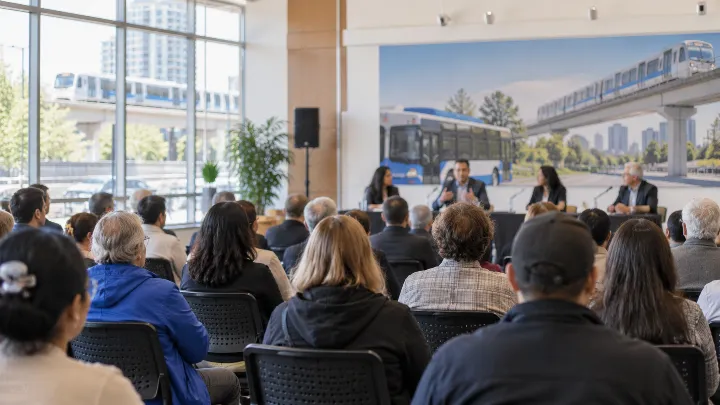
Affordable, accessible public transportation was a key topic at an Oct. 8 election town hall at City Centre library, where five mayoral and council candidates took questions. Movement, Surrey Citizen, Dogwood BC and Women Transforming Cities hosted and sponsored the event. Mayoral candidates Doug McCallum (Safe Surrey Coalition), Mike Starchuk (Imagine Surrey) and Igal Ammons II (New Surrey+) joined council candidates Jasroop Gosal (Surrey First) and Werner Spangehl (Surrey NOW). Surrey Connect, led by Brenda Locke, was not represented.
MovementYVR opened with a presentation on Surrey’s need for more rapid transit. Executive director Denis Agar said transit service had increased by about 9 per cent since 2020. Investments in bus lanes and shelters, including in places such as Scott Road, were paying off, he said, and ridership had grown most on routes where service increased most. Candidates had three minutes to introduce themselves and two minutes to answer each question from the moderator.
Doug McCallum, Surrey’s mayor for 13 years, called SkyTrain the backbone of the city’s transportation system and promised to start building a line along King George Boulevard to Newton immediately if elected. He identified affordability, safety and infrastructure as his slate’s most important platforms, closely linked to transportation development. Asked how to fund safer crossings, sidewalks, lighting, seating, shelters, shade, tree canopies and access to public washrooms, McCallum said too much attention had gone to routes and types of transportation. The priority, he said, should be improving the environment around Surrey bus stops. He also said he wanted some of the money given to the federal and provincial governments to return to cities for better infrastructure and transportation. He said he had used that approach to build major infrastructure projects that would benefit Surrey for the next 50 years.
Jasroop Gosal, attending for Surrey First in Linda Annis’s place, said Surrey needs better east-west transit connections, while ensuring infrastructure is built in the right places. Citing a 2025 Surrey road survey by the Surrey Board of Trade, he said new rapid transit corridors should go where needs are growing: Newton to South Surrey, City Centre to Newton, and along 104 Avenue between City Centre and Guildford. Surrey has grown quickly but its infrastructure has not kept pace, Gosal said. He called for an end to switching back and forth between transit modes, saying the city should commit and build, secure a fair share of investment, and use taxpayers’ money efficiently.
Surrey First’s affordable-transit platform also includes doubling sidewalk construction and improving the city’s 50 highest-priority intersections to help keep people safe while travelling to and from transit. Mike Starchuk, a former city councillor and BC NDP MLA for Cloverdale, said access to a washroom should not be such a desperate human-rights issue. He and Imagine Surrey support building facilities and improving utilities at transportation hubs and along transit routes, including bus shelters, public washrooms and bus parking spaces.
Starchuk described his plan as simple: bulk-buy passes and create a “Surrey Pass.” He was referring to a proposed $70 one-zone fare in Surrey and said buying in larger quantities would lower the cost. Another campaign priority is to build and maintain 50 kilometres of sidewalks over the next term. He suggested the city take back the right to install bus shelters from Pattison Outdoor Advertising when its contract expires, to speed construction.
Werner Spangehl, speaking for Surrey NOW leader Troy Van-Vliet, said continued growth would require strategically designed transportation hubs to connect different parts of the city, with efficient bus service the best way to do that. Asked how to find money for transit projects, Spangehl said the first step would be an audit followed by a zero-based budget exercise. Better fiscal accountability and accurate budgeting, he said, would make it possible to spend on more priorities. His slate would prioritize express bus lanes connecting transportation hubs because a train would not be affordable within the next term.
New Surrey+ leader Igal Ammons II said he was advocating for a city for everyone. Asked whether he would introduce a new speed limit to protect people who do not drive, he said he would not spend time lowering the limit; instead, he would deal with people who speed and address why they do so. His approach includes adding services such as daycares, schools and businesses within neighbourhoods to keep traffic down. His platform also proposes an overhead link connecting Surrey residents with the rest of B.C.
Agar said riders across Surrey had described a major missing link in getting around the city. To consider how to fix it, he suggested imagining the kind of experience people would want their grandmother to have when taking the bus.