 Vancouver
METRO VANCOUVER NEWS
YVR reportedly first in line for Carney’s airport privatization plan, with First Nations stake of up to 20 per cent
The federal government has reportedly identified Vancouver International Airport as the first airport to pursue private investment under Prime Minister Mark Carney’s plan. The proposal remains at an early stage and could give First Nations investors a minority stake of up to 20 per cent.
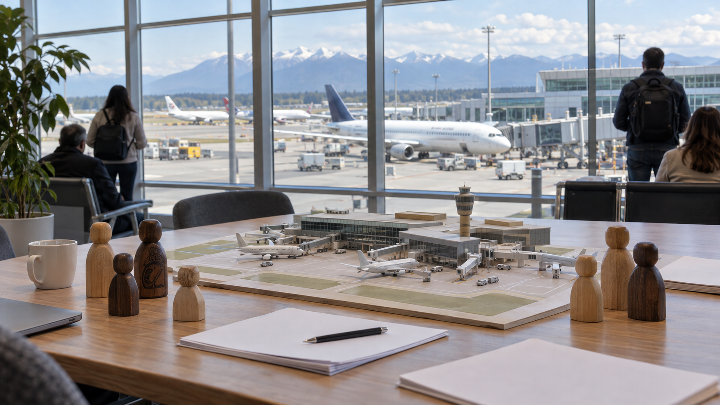
Prime Minister Mark Carney announced in September 2026, during an address to the Canada Investment Summit, that his government would open privatization opportunities at Canada’s four busiest airports: Vancouver International Airport, Calgary International Airport, Toronto-Pearson International Airport and Montreal-Pierre Elliott Trudeau International Airport. His administration estimates the plan could generate tens of billions of dollars in new revenue.
The Globe & Mail reported on Oct. 7 that federal officials have identified Vancouver International Airport (YVR), Canada’s second-busiest airport, as the first to pursue privatization, partly because they anticipate attracting First Nations investment. The proposal could involve selling a long-term lease to operate the airport while the federal government retains ownership of the land, buildings, facilities and infrastructure. The Globe reported that First Nations investors could hold a minority stake of up to 20 per cent, with institutional investors experienced in airport operations acquiring the rest and holding majority control. Potential candidates include large Canadian pension funds such as PSP Investments, which already operates airports in Europe and Puerto Rico. The federal process remains at an early stage.
The proposed change would be a major departure from the model in place at Canada’s largest airports since 1992. Under that system, non-profit airport authorities, including Vancouver Airport Authority, operate the facilities, pay annual rent to the federal government and collect revenue from passengers, airlines and commercial tenants. YVR’s annual ground-lease payment is calculated on a progressive scale based on percentages of the airport authority’s total revenue. Vancouver Airport Authority’s financial statements show a $78-million ground-lease payment in fiscal 2025, up from about $74 million in fiscal 2024.
YVR reported a $50.4-million deficit in 2025, compared with a $19.5-million surplus in 2024. Operating revenue was $718 million, exceeding operating expenses of $674 million and producing a $45-million operating surplus. After interest, investment income and other items were accounted for, however, the airport authority ended the year with an overall deficit. The results included $73.3 million in non-cash asset write-downs, primarily a $62-million reduction in the recorded value of a ground transportation facility. The airport authority has an optimal credit rating.
Potential First Nations participants in the YVR proposal could include the Musqueam Indian Band, which already receives revenue generated by airport activity through several arrangements. In early 2025, the band and the federal government reached an agreement setting aside a portion of annual federal revenues generated by YVR for the First Nation, as Daily Hive Urbanized previously reported. That builds on a 30-year reconciliation partnership Vancouver Airport Authority signed with the Musqueam Indian Band in 2017, under which the First Nation receives one per cent of YVR’s non-aeronautical revenue. In the first year of that YVR agreement, the band received more than $5 million directly from Vancouver Airport Authority.
After Carney’s announcement, the Musqueam Indian Band said in a September 2026 statement that it was proud of its strong relationship with Transport Canada through revenue-sharing and partnership agreements, and welcomed meaningful dialogue about YVR’s future and any possible government approach to changing the current operating model. The statement said the Musqueam’s unique role at YVR had brought stability and mutual benefit to the airport and Musqueam people. The band said it looked forward to taking part meaningfully in any change, and would take time to understand the Prime Minister’s announcement before looking to next steps.
The federal government has also reportedly contacted MST Development Corporation to gauge its potential interest. The real estate company is jointly owned by the Musqueam, Squamish and Tsleil-Waututh First Nations and is behind major Vancouver residential projects including the Heather Lands and the Jericho Lands.
A Vancouver Airport Authority spokesperson told Daily Hive Urbanized that the authority has been “engaging productively” with the federal government for several months, following Carney’s Spring Economic Update, which signalled the government’s intention to explore private investment opportunities in Canadian airports. The spokesperson said YVR would continue engaging with the Government of Canada and Musqueam, given their unique relationship and the Sustainability and Friendship Agreement signed in 2017. As the work advances, the authority said it looks forward to exploring how private investment could continue to improve the passenger experience, support its people and community, and deliver long-term economic value for the region and Canada. The federal government is leading the process.
Under the current model, locally based non-profit authorities operate Canada’s largest and busiest airports and reinvest all proceeds from operations in the airports. A shift to a for-profit model would bring in additional stakeholders with a financial interest. That could put upward pressure on fees paid by passengers and commercial airlines, potentially leading to higher airfares.