 Vancouver
METRO VANCOUVER NEWS
Mohawk language teacher, 73, earns McGill’s first PhD in Indigenous Language Revitalization
Mary Onwá:ri Tekahawákhwen McDonald has taught Mohawk to thousands of students over decades. At 73, she became the first graduate of McGill University’s PhD program in Indigenous Language Revitalization.
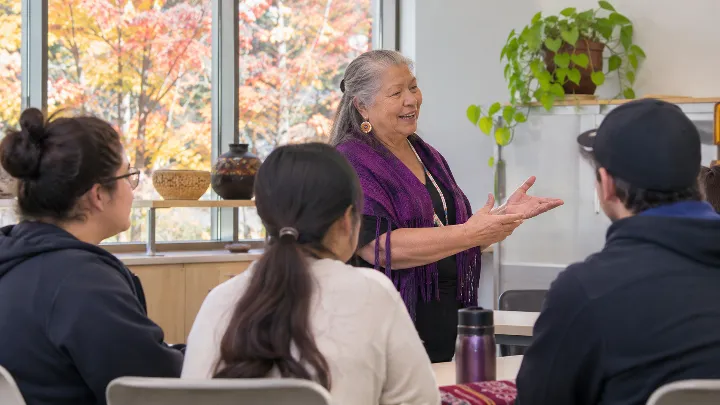
By her own estimate, Mary Onwá:ri Tekahawákhwen McDonald has taught Mohawk to thousands of students over decades, from elementary school through university. When someone suggested she pursue a PhD, the idea of returning to class in her 70s felt daunting. The now-73-year-old recalls laughing and asking why she would do it, and wondering whether she could compete with 20-year-olds or manage the work.
Earlier this year, McDonald became the first person to graduate from McGill University with a PhD in Indigenous Language Revitalization. The Mohawk educator, linguist and elder said she was eventually persuaded to apply because she wanted to record knowledge gathered through 45 years of teaching and studying language.
McDonald is from Akwesasne, a community spanning Quebec, Ontario and New York. A native Mohawk speaker, she did not learn English until Grade 2. She later studied Iroquoian linguistics, specializing in Mohawk, at university in Albany, N.Y., and earned a teaching certificate in Ontario.
Over the years, she became interested in how children who speak a language natively learn it. She said “kinship words” for close relatives come first, followed by words for other people close to them. Pronouns, commands and nouns come later as children learn increasingly complex sentences. She said that knowledge can also help second-language students. “If you follow this pattern, you’re coming very close to duplicating a natural learning pattern,” she said.
McDonald summarized part of her research in her dissertation, “Kanien’kéha Through the Eyes of a First-Language Speaker.” Along the way, she became a peer mentor to some of the students in their 20s she had once felt intimidated to join. She recently invited reporters to meet some of her young peers as they gathered to discuss their research. She spoke Mohawk with a young man and advised another student who was presenting to the group. McDonald jokingly calls them fellow “super-nerds.”
Jessica Coon, director of the ad hoc graduate program in Indigenous language revitalization and one of McDonald’s supervisors, said McDonald’s contribution to the program is “hard to overstate.” In an interview, Coon said supervisors always learn from their students, but that was especially true with McDonald because of how much she knows about the language.
Coon said the program was created in part for students whose interest in language revitalization spans disciplines, as McDonald’s does across linguistics and education. The program aims to accommodate students approaching the revitalization of their languages from different perspectives and to provide flexibility across disciplines, she said.
Another student graduated with McDonald at the master’s level, Coon said, and four more students started this fall, including two PhD candidates. “She is the first, but she won’t be the last,” Coon said.
McDonald now describes herself as retired, but remains busy. She returns to McGill every two weeks, where she serves as an elder in residence and meets with the research group. She also continues working with more advanced Mohawk language learners, encouraging them to expand their abilities and express themselves with accuracy and “pizzazz.”
She plans to build on her thesis and write down concepts she has spent a lifetime studying. “I’ll do this till the day I pass because it’s a lot of fun,” she said.