 Vancouver
METRO VANCOUVER NEWS
Canada’s fractured immigration consensus is beginning to show at the ballot box
Immigration is becoming a political fault line in Alberta and Quebec. Albertans will vote Monday on five immigration questions alongside a future separation referendum, while Quebec’s new Parti Québécois minority government has pledged to tighten controls.
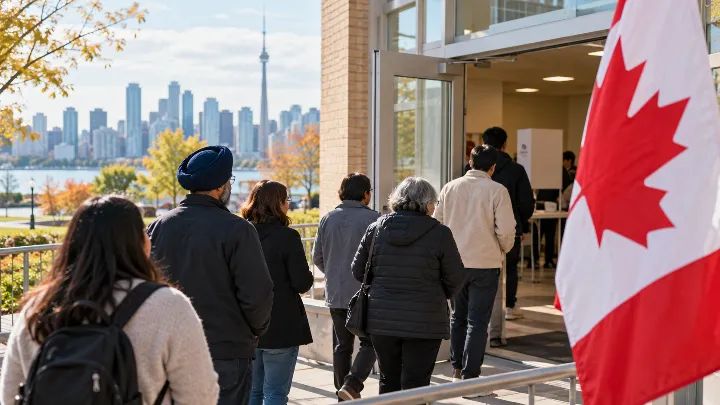
Canada’s long-standing consensus on immigration has fractured amid a rapid rise in arrivals after the pandemic and growing affordability pressures. That division is beginning to show at the ballot box.
The Parti Québécois won a minority mandate in Quebec on a platform that included tighter immigration controls, which the party linked to protecting French culture and easing pressure on public services and housing. Albertans voting Monday on whether to hold a future referendum on separation from Canada will also answer five immigration questions advanced by Premier Danielle Smith’s government: whether the province should have more say over economic immigration; whether provincially funded services should be limited to citizens, permanent residents and people with “Alberta-approved” immigration status; whether non-permanent residents should pay to access health care and education; whether they should have to live in Alberta for at least 12 months before qualifying for provincially funded social supports; and whether voters should have to prove citizenship to vote provincially.
Former Alberta premier and federal immigration minister Jason Kenney said Canada needs a broader, fact-based debate on immigration policy. In an interview with The Canadian Press, he said demographics will shape the country’s future and few issues are more important. The debate should be disciplined, respectful and thoughtful, he said, drawing as much as possible on evidence, data and experience from around the world.
Kenney warned that immigration debates can be sidetracked by extreme political views, including accusations of racism from the far left and actual racism on the far right. He does not consider the Alberta ballot questions race-based or xenophobic, but said the separatist movement is a different matter. He cited Mitch Sylvestre, leader of the main separatist organization, who has said that in his envisioned Alberta republic, citizenship would be limited to people born there. Kenney said currents on the extreme right of Alberta politics should concern everyone, but that does not rule out a mature conversation about immigration.
Some diaspora communities in Alberta are troubled by the questions. Lawyer Avnish Nanda, co-founder of advocacy group Our Alberta Advantage, is campaigning for a “no” vote on the immigration questions. He said responses from the province’s cultural communities and people who have considered running for the United Conservative Party have been overwhelmingly negative. They see the questions as targeting them, their journeys to Canada and the roots they have built over the past 60 years, he said. Nanda said people feel fear, confusion and anger toward the government, and believe the questions are unnecessary and tied to the separatist effort. He said they believe Smith is scapegoating them to retain support from the more extreme separatist elements that brought her to power.
Nanda said the referendum is bringing out ugly undercurrents in Alberta. His parents were recently “jeered by a couple of white guys in a car” while out walking, he said; it had never happened to them since they came to Canada in the 1970s. He said the questions affect everyone, citizen or not, because many people mobilized in support of them do not distinguish between those who have lived in Canada for 40 years and those who arrived a week ago: “we all look the same to them.”
Nanda said passage of the immigration measures on Monday could undermine Canada’s multicultural identity, while limits on access to provincial services would make integration harder for newcomers. He said some of the loudest opposition has come from chambers of commerce, representing businesses struggling to recruit staff. Someone in politics needs to champion the view that immigrants support economies, expand the tax base and help fund social programs and services, he said. Nanda attributed affordability pressures in communities to failed government investment in education and health care, and argued that immigrants being scapegoated could help reverse the problem. He said many nurses and support staff in rural Alberta hospitals and long-term care facilities are immigrants because local workers cannot be found; the same is true in many educational facilities.
In Quebec, the new Parti Québécois minority government campaigned on tighter immigration controls. Quebec has had much more control over its immigration system than other provinces since 1991. The party’s platform included reducing annual permanent resident admissions from 45,000 to 35,000, imposing a moratorium on permanent immigration from outside Quebec, prioritizing permanent status for temporary residents already in the province, and tightening selection criteria for temporary workers.
Catherine Xhardez, a political science professor at the University of Montreal, said the outgoing Coalition Avenir du Québec government politicized Quebec’s immigration debate by introducing restrictions that the new government now wants to strengthen. Before that, she said, parties generally agreed migration benefited the economy, demographics and even the French language. Before 2018, Quebec’s major parties largely agreed immigration could strengthen francophone culture by prioritizing certain immigrants, she said. The CAQ broke that consensus by arguing there was too much immigration too quickly and that numbers should be lower.
Xhardez said a key difference is that Alberta’s debate centres on populist claims that immigrants are responsible for shortages in social services, while Quebec’s debate puts identity and culture first. Immigration has also become a bargaining chip for Quebec’s government in its dealings with Ottawa, she said.
Smith wants a bargaining chip of her own. In a video released Wednesday, she urged Albertans to support the nine immigration and constitutional questions in the referendum to “send Ottawa a message.” One question, she said, is meant to “give us the same power as Quebec to recruit economic migrants.” During a pro-unity campaign stop in Calgary on Thursday, Prime Minister Mark Carney urged people to vote “no to the nine,” a phrase that has become a rallying cry among opponents of separatism.
Kenney said he is sceptical of greater provincial control over immigration, a “sensitive” policy area. He said provinces lack the federal government’s ability to detect fraud and tend to focus on local concerns rather than immigration’s effects on the national economy. In western provinces, he said, permanent residents they recommend are often low-skilled temporary foreign workers converted to permanent status because local MLAs tire of pressure from Tim Hortons franchise owners.
Reflecting on his time as Alberta premier, Kenney said “certain premiers” told Ottawa after the COVID-19 pandemic that increasing immigration was their top priority, despite early signs of the housing and youth unemployment challenges now driving the debate. When people lack social permission to discuss these issues, he said, public opinion can become detached from elite opinion, as he believes is happening in European politics. To avoid politics resembling Alternative für Deutschland, Front National or U.K. Reform, he said, Canada needs a proper, open debate.
Xhardez, who is originally from Belgium, said Canada’s political scene differs greatly from Europe and the United States: there is no mainstream anti-immigrant party at the federal level. Public sentiment has shifted, however, and no one knows for certain what that will mean for Canadian politics. Canada may not be so exceptional, she said, or it may become exceptional by being less politicized, but the consensus and strong public support are no longer there.