 Vancouver
METRO VANCOUVER NEWS
YVR’s own Come From Away: Airport welcomed 8,500 travellers stranded after 9/11
Thirty-four diverted flights carrying about 8,500 people arrived at Vancouver International Airport after the Sept. 11 attacks, prompting a days-long response from airport staff, airlines and the community.
Canada’s Operation Yellow Ribbon is often associated with Gander, N.L., where a town of about 10,000 people received 38 diverted aircraft carrying nearly 7,000 people after the Sept. 11, 2001, terrorist attacks. The response later inspired the Tony Award-winning Broadway musical Come From Away, which Arts Club Theatre Company staged at the Stanley BFL Canada Stage this summer.
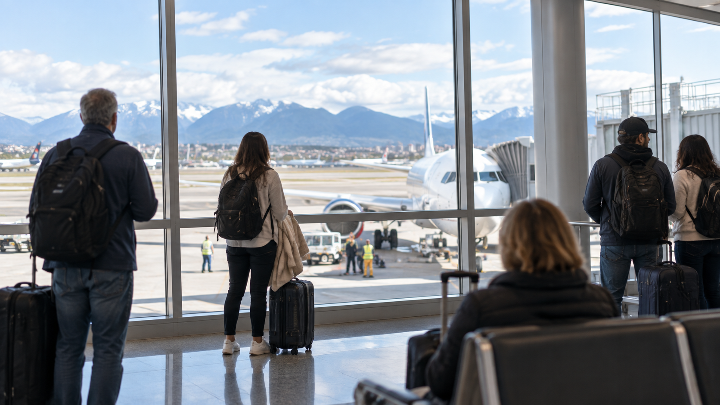
On the other side of the country, Vancouver International Airport also faced an extraordinary influx. With U.S. airspace closed to commercial aircraft and regular passenger departures grounded in Canada, YVR received 34 diverted wide-body flights carrying about 8,500 people. Brett Patterson, now YVR’s director of operational excellence and improvement, said it was the largest number of unexpected passengers accepted by any Canadian airport that day.
Patterson, then the manager of airside operations, said more than 60 aircraft were already on the ground when departures stopped, filling gates and parking positions needed by the incoming flights. Airport staff worked with Nav Canada on a parking plan, using the north runway, crosswind runway and taxiways for large aircraft while keeping one runway and its taxiway available.
Getting passengers into the terminal was another challenge. Aircraft at gates had to be unloaded and moved, while arriving planes were brought to gates, connected to boarding bridges and pushed back after passengers disembarked. Patterson estimated that passengers on the final aircraft waited more than eight hours after landing to get off. Water was delivered to planes, while checked baggage remained onboard so travellers could enter the terminal more quickly with only carry-on belongings.
Danielle Moore, now YVR’s operations centre manager, said some crews on airlines that did not usually serve YVR had little information about why they had been diverted. Passengers arrived in an unfamiliar place as alarming news emerged from the United States and relatives tried to locate them. Travellers were screened before entering the terminal and cleared Canadian customs in stages; some also required medication or other special assistance.
Hotels were sought as far away as Hope in the Fraser Valley, with community centres also used for accommodation. Residents across the Lower Mainland called to offer spare bedrooms, while others offered recreational vehicles. YVR employees, airline workers and family members distributed blankets, sunscreen and water; the Salvation Army helped feed people, and doctors from the airport clinic assisted.
The response continued well beyond normal shifts. Staff slept in airport offices and moved into whatever work was needed, from assisting passengers in the terminal to managing queues. Some travellers bound for Seattle continued by bus, but restarting flights required aircraft to be cleaned and prepared, along with new security procedures that Transport Canada updated almost hourly.
Moore recalled that passengers began leaving again about three days after the attacks, though the disruption took the better part of a week to work through. Crowds eventually extended from the terminal to the curb and onto the roof of the parkade, where cars were towed away to create temporary waiting areas. Moore said several New York City firefighters stranded at the airport later volunteered to help load boxes of bottled water into a truck.
Patterson, Moore and Barb Maloney, now YVR’s director of operations safety and security, said the experience reflected the same willingness to help that became associated with Gander’s response. Maloney noted that Metro Vancouver had far more population and infrastructure to draw on, but said people readily stepped forward during a highly complicated event.