 Vancouver
METRO VANCOUVER NEWS
Five Vancouver mayoral candidates outline plans for residents and businesses
At a Greater Vancouver Board of Trade forum, Ken Sim defended his record while four challengers set out different approaches to public safety, city costs, permitting, housing and economic development.
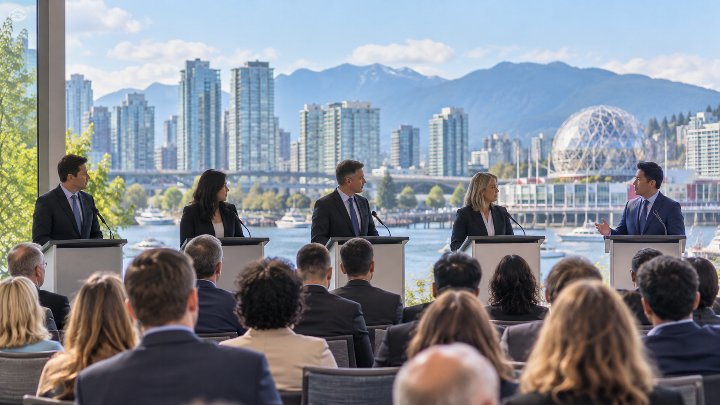
Five leading candidates for Vancouver mayor laid out sharply different proposals on public disorder, municipal costs and development approvals at a joint session with the Greater Vancouver Board of Trade (GVBOT) and Metro Vancouver’s business community on Friday, Oct. 2, 2026. The session took place ahead of the Oct. 17 civic election. The candidates were incumbent Ken Sim of ABC Vancouver; sitting city councillor Pete Fry of the Green Party of Vancouver; political strategist Kareem Allam of the Vancouver Liberals; sitting councillor Rebecca Bligh of Vote Vancouver; and former councillor Colleen Hardwick of TEAM For A Livable Vancouver. Several candidates cited GVBOT’s June 2026 member survey, which identified permitting delays, paperwork, property taxes, and the condition of streets and public spaces amid public disorder as business concerns.
Sim defended ABC’s record, acknowledged that his administration had not accomplished everything it intended and said some decisions had been imperfect. He argued that it had made substantial changes and deserved a second term. He cited funding for 100 additional police officers, more than 50 added mental health workers, the creation of Vancouver Police Department District 5 to improve policing in the Downtown Eastside, and the launch of Task Force Barrage to target organized crime. He also pointed to work in Chinatown and Gastown, efforts to improve the Granville Entertainment District, investments in fire services, community centres, roads and sidewalks, and Vanstat, a system intended to hold city departments accountable for performance.
Public safety was central to Sim’s remarks. He said people’s comfort in public spaces affects whether customers visit downtown, businesses can thrive and residents enjoy a good quality of life. He urged voters to support two public safety plebiscite questions: improving enforcement against public use of hard drugs, and asking the provincial government to create a secure medical treatment facility somewhere in Vancouver for people with severe mental health and addictions issues. The proposed facility would include at least 100 involuntary care beds as well as additional voluntary care beds. Sim said leaving people in crisis on sidewalks was not compassionate and criticized repeated emergency responses by police, firefighters and paramedics that did not resolve people’s need for care.
Asked how the plebiscite could lead to practical changes, Sim said renewed bylaw enforcement could let police issue tickets and confiscate drugs used in public without arresting people. He contrasted that approach with what he described as a lengthy sequence of arrest, charges, a report and referral to prosecutors. In his view, a bylaw would offer a simpler enforcement option and re-establish expectations for conduct in public spaces. He compared it with restrictions on smoking near building entrances, arguing that public hard-drug use should not be accepted as an unavoidable part of city life. During questions, he acknowledged that public disorder had increased, attributing it to policies of the BC NDP-led provincial government, gaps in health care and public drug use. His response, he said, would combine ongoing support for police and fire services with pressure on the province to provide treatment.
On business, Sim drew on his experience operating Rosemary Rocksalt bagel shops in Vancouver and said he understood the frustration of the city’s permitting and licensing processes. He said his administration had cleared application backlogs, removed more than 2,000 pages of bylaws, introduced online and digital processes, and eliminated unnecessary steps. Over the past four years, he said, the number of business licence categories had fallen from nearly 600 to fewer than 100, while the time to approve an application dropped from 16 weeks in 2022 to two days. He offered the figures as evidence of progress while acknowledging that more work remained. He also cited the zero per cent property tax increase in 2026 as an accomplishment.
Sim criticized Fry for opposing funding for more officers, Task Force Barrage, the property tax freeze and continuation of Granville Street’s temporary pedestrian zone after the FIFA World Cup. He said the disagreements represented a choice between continuing ABC’s direction and returning to earlier municipal approaches. Asked what he hoped to show after another four years, Sim said he wanted Vancouver to be known for successfully addressing street disorder rather than for the crisis in the Downtown Eastside.
Fry presented himself as an experienced councillor with a small-business background who was willing to challenge the current administration. He said he had served on Vancouver City Council for eight years and had spent his career running or working in small businesses before entering municipal politics. He described the pandemic as a major challenge during his first term, while pointing to public plazas where people could consume liquor and changes intended to give restaurants and bars more operating flexibility. In the current term, he said, he had increasingly scrutinized decisions by the ABC-led council. He cited his opposition to Sim’s earlier proposal to eliminate the separately elected Vancouver Park Board commissioners, his criticism of the city’s handling of the integrity commissioner, and his objection to Sim’s proposal to invest city treasury funds in Bitcoin.
Budget transparency was a major part of Fry’s case. He criticized the reduced level of detail in a recent annual budget document compared with documents from past budget cycles. If elected, he said, one of his first priorities would be to obtain a detailed account of spending, fee changes and the implications of the 2026 property tax freeze. He supports keeping property tax increases in line with inflation but did not promise a freeze.
For public safety, Fry proposed a 24/7 team of non-police outreach workers to respond to non-emergency situations. The Community Response Outreach Workers (CROW) Team would be a non-medical mobile service for calls involving people experiencing homelessness, perceived street-level addiction, public intoxication and mental health crises. Its goal would be to help before a situation escalates to police intervention. Fry also proposed expanding daytime services and shelters, providing access to toilets and creating places where people could leave the streets and connect with support. He acknowledged that businesses need more help with public disorder, vandalism and safety concerns for staff and customers.
Fry proposed a new Office of Community Safety to coordinate police, firefighters, other first responders and city departments, including those responsible for business licensing and permits. He said coordination would help the city respond more promptly to problems at specific locations. Implementing CROW would be an early priority, alongside reversing restrictions on supportive housing and overdose prevention sites (OPS). Fry said the city should take more responsibility for issues it can address directly rather than wait for senior governments. At the same time, he called for new operating rules for supportive housing and OPS facilities to help manage their effects on surrounding neighbourhoods. He said opening a bar or restaurant involves more conditions than operating social services in Vancouver, and argued that this should change.
For businesses, Fry proposed a Business Navigator Office as a consistent point of contact at City Hall to help owners navigate requirements across departments. Asked how it would differ from the existing Business Assistance Office, he emphasized having one contact who could guide applicants through the range of requirements. He also promised faster approvals when a property’s use changes, noting that businesses can pay rent for months while waiting for permission to proceed with a change of use and renovations. Another priority would be protecting small businesses from property tax increases tied to redevelopment potential. Fry warned that an expiring relief program could expose businesses to higher bills when properties are valued for what could eventually be built there.