 Vancouver
METRO VANCOUVER NEWS
David Eby says George Massey Tunnel work is too far along to abandon as early construction advances
B.C. Premier David Eby says replacing the in-progress immersed tunnel with a proposed 10-lane bridge would disrupt work, threaten jobs and put up to $3 billion in federal funding at risk. Major construction is expected to start in 2027.
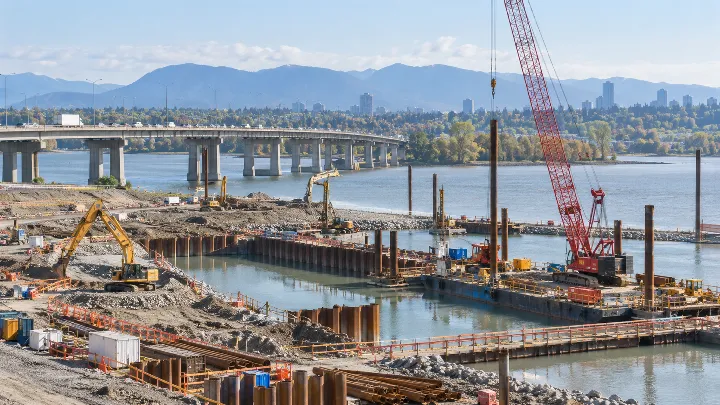
Premier David Eby argued that the BC NDP government’s George Massey Tunnel project has advanced too far to abandon. At the Deas Island early works site, he rejected a campaign pledge announced the previous day by B.C. Conservatives leader Lorne Doerkson to cancel the $8.5-billion, eight-lane immersed tunnel and revive a 10-lane bridge plan. “The idea that we would abandon this project at this stage is the stupidest idea I have ever heard,” Eby said. He said the tunnel is being built for British Columbians and that work is visibly underway.
Eby questioned how stopping work, removing the preparations and starting over could produce a cheaper replacement crossing without further delays. He said the current preparations had already taken a year and predicted another dozen cranes would be operating at the site within a few months. He challenged Doerkson to visit and see the hundreds of people working there, and questioned whether a restart could cost less and meet the same schedule.
Early construction and site preparation for the immersed tunnel have been underway at Deas Island since January 2026, beside the existing tunnel’s southern entrance. The work includes clearing land, relocating utilities and preparing temporary major facilities, including a large basin to cast and float out prefabricated concrete tunnel segments. Major construction is expected to begin in 2027. The provincial environmental assessment review, originally scheduled to finish in late 2024 or 2025, is now expected to conclude before the end of 2026. The review began in 2021, when the BC NDP government first confirmed it would proceed with an immersed tunnel.
Construction is underway, but the major tunnel contracts have not been awarded. The province restarted procurement this past spring and overhauled it in June 2026 after dismissing the original European private consortium selected in summer 2024 to design and build the project. The new approach divides the work into five smaller contracts instead of one large contract, with the stated aims of increasing competition, creating more opportunities for domestic companies and controlling costs. Procurement for the first two contracts began in June 2026, with successful bidders expected to be selected by early 2027. Bids for the other three are scheduled for 2027.
Earlier this week, Doerkson said the BC NDP government’s cancellation of the previous bridge project nearly a decade ago had left commuters facing years of unnecessary congestion. The 10-lane bridge plan was advanced by the BC Liberals government of then-premier Christy Clark. The $3.5-billion project included major new interchanges, widening Highway 99 between the south end of the Oak Street Bridge and Delta, and extensive bus rapid transit infrastructure with purpose-built bus-only lanes that could potentially have been converted for a future SkyTrain extension. The province cancelled it a few months after John Horgan and the BC NDP took office in 2017, when it had reached a similar stage of early works and site preparation.
The cancellation came only months before a contract award and the start of major construction. The province forfeited about $100 million already spent on design, planning and early works. It had also received a notably low fixed-price bid of $2.6 billion, $900 million below the B.C. Ministry of Transportation and Transit’s $3.5-billion estimate. It is not immediately clear how much the BC NDP government has spent to date advancing the broader Fraser River Tunnel Project; the article describes the amount as certainly in the hundreds of millions of dollars. That includes the project’s much smaller Highway 99 upgrades compared with the bridge plan, such as the recently completed Steveston Highway interchange and bus-on-shoulder lanes.
Federal funding is another part of Eby’s objection. Prime Minister Mark Carney announced up to $3 billion for the tunnel project this summer. It is unclear whether the funding could readily be redirected to a bridge, but Eby warned that it could disappear. “We have three billion dollars in federal funding that would be vaporised by the Conservatives announcement with no explanation of where they’re going to get that money from,” he said. There is a local precedent for transferring committed federal transportation funding: after the Surrey Newton-Guildford LRT project was cancelled in 2018, its allocated funding, including the federal contribution, was eventually formally transferred to the replacement Surrey-Langley SkyTrain project. Eby also pointed to tolls in the old bridge plan; the BC Liberals’ proposal included tolls, while the BC NDP’s eight-lane immersed tunnel is intended to be toll-free.
The replacement crossing has become a major issue again ahead of the Oct. 24, 2026, provincial election, especially after a sharp rise in the tunnel’s estimated cost. When the BC NDP government confirmed the immersed tunnel in 2021, its budget was $4.15 billion and the target opening was 2030. In July 2026, the estimate rose to $8.5 billion and expected completion was pushed back to September 2031. Reasons given for cancelling the earlier bridge included its perceived size and number of vehicle lanes, as well as opposition from some municipal governments. The City of Richmond was a vocal opponent and wanted a tunnel solution. The bridge also faced strong opposition from the Green Party of British Columbia, which the BC NDP relied on to maintain its minority government after the party helped defeat Christy Clark’s BC Liberal minority government in 2017. Shortly after the bridge was cancelled, a regional task force of selected Metro Vancouver mayors recommended an immersed tunnel instead; the BC NDP government advanced its alternative in line with that recommendation.
The bridge was not the only major infrastructure project the BC NDP reconsidered after taking office in 2017. Its government also reviewed whether to cancel the Site C hydroelectric dam, then well under construction. Opponents, including Horgan and the BC Greens, questioned its cost, environmental effects and whether more electricity was needed. Horgan ultimately chose to finish construction, arguing cancellation would leave British Columbians with billions of dollars in costs and nothing to show for it. The province cited about $2.1 billion in construction and planning expenditures expected by the end of 2017, plus an estimated $1.8 billion in costs to terminate the project and restore the site.
Site C became fully operational in 2025, when its sixth and final generating unit entered service. In May 2026, the BC NDP government officially named it the John Horgan Dam and Generating Station, honouring the late premier’s decision to see it through. BC Hydro is meanwhile seeking more power to meet rising demand driven by population and economic growth, and the shift from fossil fuels to electricity in buildings, transportation and industry. Its long-term planning includes exploring potential major new hydroelectric projects.