 Vancouver
METRO VANCOUVER NEWS
Vancouver and Surrey mayors back Pacific Link pipeline as Delta mayor seeks role in planning
Ken Sim says Vancouver will not mount a legal challenge, while Brenda Locke supports the proposal. George Harvie wants Delta involved in planning and assessing combined local impacts.
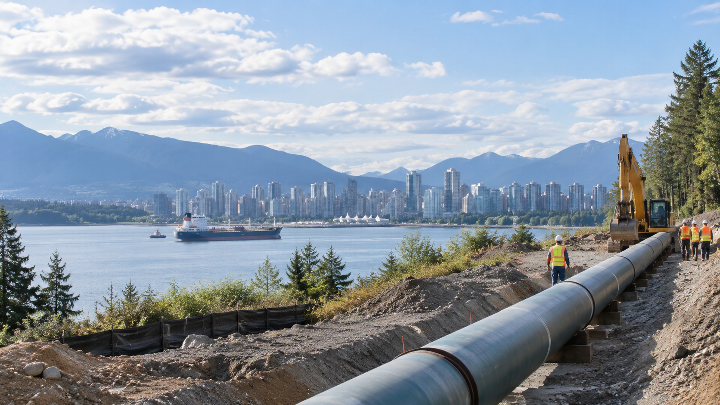
Vancouver Mayor Ken Sim has ruled out a municipal legal challenge to the proposed Pacific Link oil pipeline, while Surrey Mayor Brenda Locke has voiced strong support. Delta Mayor George Harvie wants his city involved in pipeline planning and in addressing local effects. In separate statements over the past week, all three mayors welcomed the prospect of investment and jobs. Their comments followed Prime Minister Mark Carney’s decision to designate the new pipeline a project of national interest.
The proposed line would run from the Edmonton area to the B.C. coast, largely following the existing Trans Mountain corridor until it reaches the eastern Lower Mainland. The project could include a major marine export terminal at Roberts Bank in Tsawwassen, with a new man-made causeway peninsula alongside the two existing causeways serving BC Ferries’ Tsawwassen terminal and the GCT Deltaport/Westshore terminals. The pipeline could also pass through Delta to reach the export terminal. Pacific Link is proposed to carry an additional one million barrels of Alberta oil a day to the West Coast for export. The federal government says expanding access to Asian markets would reduce Canada’s current reliance on the United States.
Harvie, who is seeking re-election with his Achieving For Delta party, wants an active role in planning both Pacific Link and the Vancouver Fraser Port Authority’s separate Roberts Bank Terminal 2 container facility. That project would be built as a major extension of the existing causeway. Harvie says Delta needs to assess how the pipeline and new terminal could affect residents and businesses in combination. Potential effects include changes in truck and train traffic tied to port and industrial growth, added pressure on roads, transit and public services, and impacts on farmland and the environment. He said those concerns must be weighed alongside the jobs and business opportunities the investments could bring. Major projects are usually planned and assessed individually, he said, while Delta experiences their effects collectively.
Harvie called the projects significant economic opportunities for Delta and Canada, and said the city has a responsibility to have a seat at the table and understand both the benefits and potential harms to the community. Delta’s municipal government cannot dictate every decision made by senior governments, other local and regional governments, or project proponents, he acknowledged. But he said the city must take part in those discussions and advocate for measures that address local concerns. He said that approach is not anti-development: Delta welcomes investment, good jobs, better transportation and responsible economic development. Harvie plans to seek input from residents and businesses as the projects advance and draw on his experience working with federal and provincial ministers to advocate for the community.
Carney’s national-interest designation puts Pacific Link into a single federal review process. The federal government aims to finalize the conditions needed to proceed by September 2027. In the meantime, proponents are working on detailed route planning, environmental studies, cost estimates, public and Indigenous consultations, and other preparations. Tsawwassen First Nation has said it wants direct consultation, given the potential effects of the pipeline and export terminal on its nearby lands. Roberts Bank Terminal 2 would add a new three-berth container terminal in Delta. The federal government has referred it to the Major Projects Office as part of a broader effort to expand the Port of Vancouver’s capacity and improve Canada’s trade connections.
Sim said his ABC Vancouver party supports projects that expand Canada’s access to overseas markets, attract investment and reduce reliance on any single trading partner. He described the pipeline as a federal matter and said Vancouver would not try to block it under his and ABC’s leadership, partly because it would not cross the city’s boundaries. He also ruled out hiring outside lawyers to challenge the project, arguing that Vancouver should focus on local infrastructure. Sim said he had no intention, while mayor, of launching what he called frivolous lawsuits against companies or the federal government creating jobs and economic opportunities in Canada. He also said he would not use city lawyers or high-priced law firms to block a pipeline that does not touch Vancouver city limits.
Sim’s remarks appear to refer to the high-profile municipal disputes over the Trans Mountain pipeline expansion in the 2010s. His position differs sharply from that of then-Vancouver Mayor Gregor Robertson and then-Burnaby Mayor Derek Corrigan, whose municipal administrations pursued legal challenges in opposition to the project. The expansion was expected to increase tanker visits at Westridge Marine Terminal on Burrard Inlet from about five a month to about one a day. Robertson warned at the time that a spill could damage Stanley Park and beaches; Corrigan warned of harm to tourism and the economy. Vancouver’s municipal government spent at least hundreds of thousands of dollars on expert advice and public communications. City records released in 2017 show about $400,000 was spent in the preceding years. The City of Vancouver also asked the courts to review the provincial government’s environmental approval. Robertson is now Carney’s federal Minister of Housing and Infrastructure.
Burnaby’s municipal government reported $1.12 million in legal spending between 2014 and 2018, funded through the city’s share of provincial casino revenue. Its disputes included a fight over municipal authority: the federal government enabled some Trans Mountain terminal work to proceed without approvals required under certain Burnaby bylaws, including tree-cutting permits. Former Vancouver Mayor Kennedy Stewart also strongly opposed the expansion. Before becoming mayor, he was the federal NDP MP for Burnaby South. He was arrested at a pipeline protest in 2018 and later pleaded guilty to criminal contempt of court. As mayor, he continued to oppose the project, arguing it ran counter to climate action and First Nations reconciliation. The Trans Mountain expansion was completed in 2024 after significant controversy and delay.
Incumbent Surrey Mayor Brenda Locke of Surrey Connect also expressed strong support for Pacific Link. Depending on its final route, the pipeline could pass through parts of Surrey on its way to Roberts Bank in Tsawwassen. In a statement to Indo-Canadian Voice, Locke called Carney’s decision to advance the project an important step toward diversifying Canada’s energy exports, creating good jobs and reducing reliance on any one trading partner. She said meaningful Indigenous ownership and a focus on Canadian workers and materials would strengthen the country’s economic sovereignty. Surrey Connect supports nation-building infrastructure that expands markets, generates revenue and builds long-term prosperity for communities across British Columbia and Canada, she said. Locke linked her support to a broader effort to strengthen Surrey’s economy, including diesel-tax relief for truckers, saying those measures could protect jobs and position Surrey and Canada for success in a changing global environment.