 Vancouver
METRO VANCOUVER NEWS
B.C. court dismisses challenge to approval of 229 rental homes in Vancouver’s Cambie Corridor
A B.C. Supreme Court judge found Vancouver’s approval of a 229-unit market-rental project near King Edward Station was fair and reasonable despite no below-market units.
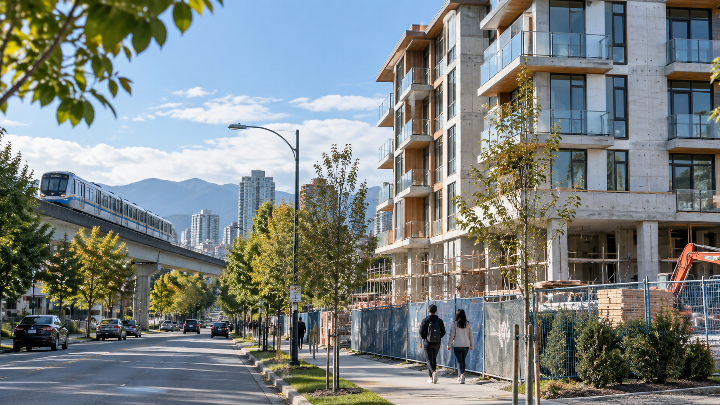
B.C. Supreme Court Justice Morellato has dismissed a Cambie Corridor Neighbourhood Association challenge seeking to overturn approval of a low-rise secured purpose-built rental project near SkyTrain’s King Edward Station. The judge found the City of Vancouver’s process was fair and Vancouver City Council’s decision reasonable, and ordered the association to pay costs to the City and developer Sightline Properties.
The project is planned for the assembly at 520-590 West 29th Ave. and 4510-4550 Ash St., about a 10-minute walk south of the Canada Line station, half a block west of Queen Elizabeth Park and one block east of BC Children’s Hospital. Council unanimously approved the July 2025 rezoning for 230 secured purpose-built rental homes in two six-storey buildings and two townhouse blocks. A development permit approved and issued in December 2025 reduced the total to 229 units.
Sightline had initially planned 46 upscale townhomes expected to sell for $2 million to $2.3 million each. According to the ruling, it obtained permits in 2022, demolished the former detached houses and began excavation, but a weaker housing market left the project without pre-sales. It then shifted to a purpose-built rental proposal as provincial legislative changes encouraged greater residential density near SkyTrain stations.
The case centred on the removal of below-market rental housing. The City’s transit-oriented rezoning policy called for at least 20 per cent of net residential floor area in such projects to be below-market rental housing, at rents at least 10 per cent below the Canada Mortgage and Housing Corporation’s citywide average. Sightline initially proposed such units, but City staff recommended an entirely market-rental project, concluding that the rezoning would not create enough additional land value to support discounted rents.
Staff noted that existing RM-8A zoning already permitted more density on the site than on most RA-1 sites in the Tier 3 King Edward Station Transit-Oriented Area. Sightline had previously paid the City a $1.2 million contribution tied to extra density for its earlier strata townhouse proposal. No community amenity contribution or other negotiated public benefit was required, although the rental project was expected to provide about $5.8 million in development cost levies and roughly $300,000 for public art.
The association argued that residents could not properly assess the removal of below-market homes without the developer’s financial projections and the City’s detailed pro forma analysis. Morellato found residents had access to the same materials considered by councillors, including a staff report disclosed seven weeks before the public hearing that explained the revised proposal and why below-market housing had been removed.
The judge accepted that the financial records were commercially sensitive and that their disclosure could affect the developer’s negotiations, competition and the City’s future dealings with applicants. She ruled that the City was not required to release the records for the hearing to be fair.
Morellato also found councillors were entitled to rely on the staff report and public submissions without repeating the financial analysis themselves. She said their hearing questions showed they considered residents’ concerns and exercised independent judgment. The transit-oriented rezoning policy did not legally bind Council, she added, and Council could reasonably regard the increase in secured purpose-built rental housing, development cost levies and public-art contribution as public benefits despite the absence of below-market units and a community amenity contribution.
Sightline cited the association’s July 2025 fundraising letter, which identified delaying building permits as a goal, favoured a return to a three-storey townhouse project and raised concerns about declining property values and neighbourhood character. The letter also said the judicial review was partly intended to align with the 2026 election cycle and allow for policy changes. Although Morellato initially allowed the association to bring the case because it raised serious disclosure questions and residents had a genuine interest in neighbourhood decisions, she ultimately dismissed the petition in full.