 Vancouver
METRO VANCOUVER NEWS
Pitt Meadows mayoral candidates debate policing, rail traffic and farmland
Incumbent Nicole MacDonald and longtime councillor Janis Elkerton sparred over rail delays, public safety, taxes, farmland, airport traffic and other issues at a Chamber of Commerce debate.
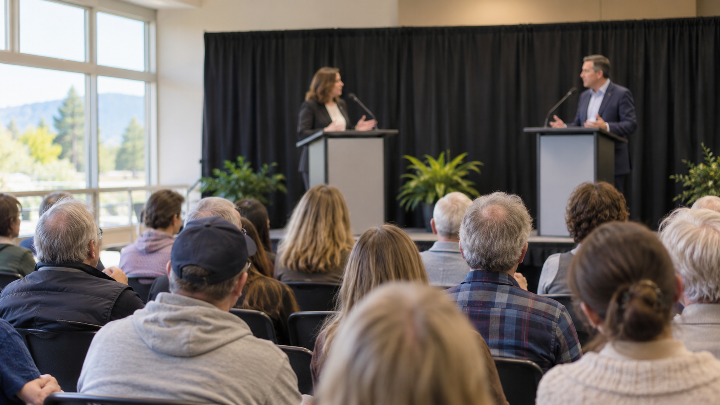
Pitt Meadows mayoral candidates Nicole MacDonald and Janis Elkerton debated rail traffic, policing and public safety, farmland protection and other issues Monday night, Oct. 5, at Pitt Meadows Heritage Hall. The Ridge Meadows Chamber of Commerce hosted the debate, moderated by former Maple Ridge mayor Ernie Daykin.
MacDonald said her council brought policing under the city’s control and increased fire protection. She said a fire crew is now on duty and ready to respond at any hour, and average nighttime response times have fallen from seven to nine minutes to two minutes and 29 seconds. For a family waiting for help, she said, that makes a difference. She also said the city has low debt and one of the region’s lowest tax rates.
Elkerton, who served 21 years on city council, spoke about fiscal responsibility and called the $21-million loan for a new RCMP detachment building a “huge tax burden on all of us.” She said tax increases of more than 30 per cent over the past four years were unsustainable and unaffordable for residents struggling to pay for household essentials in the current economic climate. She also raised flood risk and the need to improve diking and drainage, saying Pitt Meadows could not fund the work alone.
Asked about train traffic, candidates were told Harris Road is currently blocked for three and a half hours a day. The city estimates that, as rail traffic increases, the daily total will reach seven hours within 10 years. Elkerton called transportation a priority and said Harris Road needs an underpass or overpass, along with improvements to the critical intersection of Harris Road and Lougheed Highway. She said the current system is failing and was obsolete more than 15 years ago, adding that senior governments must be involved.
MacDonald said the Harris Road underpass was to be funded by Transport Canada, CPKC Rail and the Vancouver Fraser Port Authority. The estimated cost ballooned from $63 million to about $200 million, and the partners asked the city for $50 million. She said the city’s position has been that the project is not a municipal responsibility, but talks continue. She is “cautiously optimistic” given the federal push for greater independence and control over the supply chain. MacDonald called it critical infrastructure and said the question was when it would be needed, not if. She said it affects residents’ safety, livability and economic viability, adding that the city understands residents are held up at the train crossing.
Candidates were asked how they would address residents’ and business owners’ concerns about crime and disorder. Elkerton said RCMP costs are rising and she would have the city employ community safety officers who could perform duties not requiring a sworn officer at a fraction of the cost. She criticized the new 19,000-square-foot RCMP detachment, saying it had not brought an increase in service and could instead be filled with community policing. She predicted further tax increases as detachment staffing grows. Although taxes are already high, she said, they will rise again next year because the staff needed to improve service have not yet been hired.
MacDonald said public safety includes fire protection, policing, emergency planning and climate response. She said she was proud the city had brought its largest tax item, policing, back under Pitt Meadows’ control. The new Pitt Meadows office has 24 officers serving the community rather than Maple Ridge, she said. Before the city had its independent RCMP detachment, there were sometimes no officers on duty in Pitt Meadows. MacDonald said the city would have shared the cost of a new building in Maple Ridge if the policing services had not been separated. Maple Ridge’s building is “on its last legs,” she said, and Pitt Meadows would have been responsible for 20 per cent of its cost.
On the Agricultural Land Reserve (ALR), candidates were asked whether some properties should be developed for employment and industrial uses or kept for farming. MacDonald said council recently approved the North Lougheed Area Plan at the corner of Lougheed Highway and Harris Road. She called it the city’s last opportunity to get things right, expand its tax base and provide amenities such as housing, education, transportation, green space and cultural opportunities, while protecting the rest of the city’s farmland.
Elkerton said the city should support existing businesses in the ALR and diversify the activities allowed there. She said the city had ignored proper drainage and ditching on farmland, leaving a $150-million shortfall for the work. “The agricultural community feels that they have been abandoned,” she said.
Asked about increasing air traffic and plans for YPK, Elkerton said the airport has numerous flight schools and that aircraft cause residents “discomfort.” She called for a good-neighbour policy and a way for residents to communicate with the airport, as they did through a committee during her previous time on council.
MacDonald called the airport a major jobs driver that generates $800,000 in property taxes. Maple Ridge and Pitt Meadows jointly operate the regional airport, she said, and the federal government would take it over if the cities did not run it. She said increased air traffic is not solely due to flight schools: the airport is better run than it was 10 years ago, and overall traffic is higher. The full debate is available on the Pitt Meadows Chamber website, Ridgemeadowschamber.com, where it has received 1,000 views.